
A multi-market charger program does not start with a stack of national marks. It starts with a sequence: which IEC standard edition the family will be tested to, which National Certification Body (NCB) will issue the documents, which national differences will be written into the report, and which markets will be filed from that report first. The IECEE CB Scheme is the multilateral system designed for that mutual acceptance of test reports and certificates. It is not a passport that clears every customs desk on its own.
This page is an implementation path for compliance managers and OEM buyers who want to use a CB file as a multi-market plan for charger SKUs — including the national deviations buyers often miss. For factory and supplier document review more generally, see the charger-supplier evaluation checklist.
What a CB test report is for a charger in the IECEE CB Scheme — and what it is not
A CB Test Report records safety testing against a named IEC standard edition, issued with a CB Test Certificate by a participating National Certification Body. It supports mutual recognition among participating NCBs under the IECEE CB Scheme. It is not a national mark, a passport, or a substitute for USB-IF, radio or energy work.
IECEE describes the CB Scheme as an international system for mutual acceptance of safety test reports and certificates for electrical and electronic products, under a multilateral agreement among participating countries and certification organizations. A public extract of issued certificates can be consulted in the IECEE certificates database. The official scheme description is on the IECEE CB Scheme page. What a buyer holds in the PDF is a safety file for a named product and a named standard edition. It does not, by itself, authorize a CE mark, a BIS registration, a USB-IF logo or an energy label. Those remain separate procedures, even when a CB report shortens the safety portion of the work.
| Document | What it is | What it is not |
|---|---|---|
| CB Test Report | The test record against a named IEC standard edition, including any declared national differences | A national approval, or proof that every plug variant was tested |
| CB Test Certificate | The NCB’s certificate issued with that report | A mark the factory may print on a box in a target country |
| National certification or registration | The target market’s own procedure, which may use the CB file | An automatic consequence of holding a CB PDF |
Choosing the issuing NCB and the standard edition a family should follow
The issuing NCB and the IEC standard edition should be chosen before golden samples are built. For a USB charger, the safety standard in view is usually an edition of IEC 62368-1, but the edition must be the one the target markets will still accept when the national file is submitted, not the edition that happened to be in a previous project folder.
Choose an NCB that has the relevant scope and that the later recognizing bodies will actually work with. IECEE’s FAQ is clear that mutual recognition is among participating NCBs, not a vague agreement among countries. If a later market’s NCB will want its own differences tested, those differences should be in the original report or planned as a controlled amendment. Changing the edition mid-family is a new plan, not a footnote.
National deviations buyers routinely miss when they treat CB as a passport
National differences are the clauses a country declares on top of, or instead of, the IEC text. Group differences work the same way at a regional level. A CB report that was written only to the IEC common text can be a poor starting point for a market whose differences were never tested.
Buyers routinely miss plug and rating-label differences, earthing and class II constructions, markings and language, and any deviation that applies to a particular power range. IECEE publishes information on declared differences; detailed access may be limited to members, in which case the issuing or recognizing NCB is the practical source. This page will not invent a list of which countries “accept CB.” The current participation and the target authority’s own rules have to be checked for each market in the plan. Treat CB as a shared test file, not as a stamp that removes those checks.
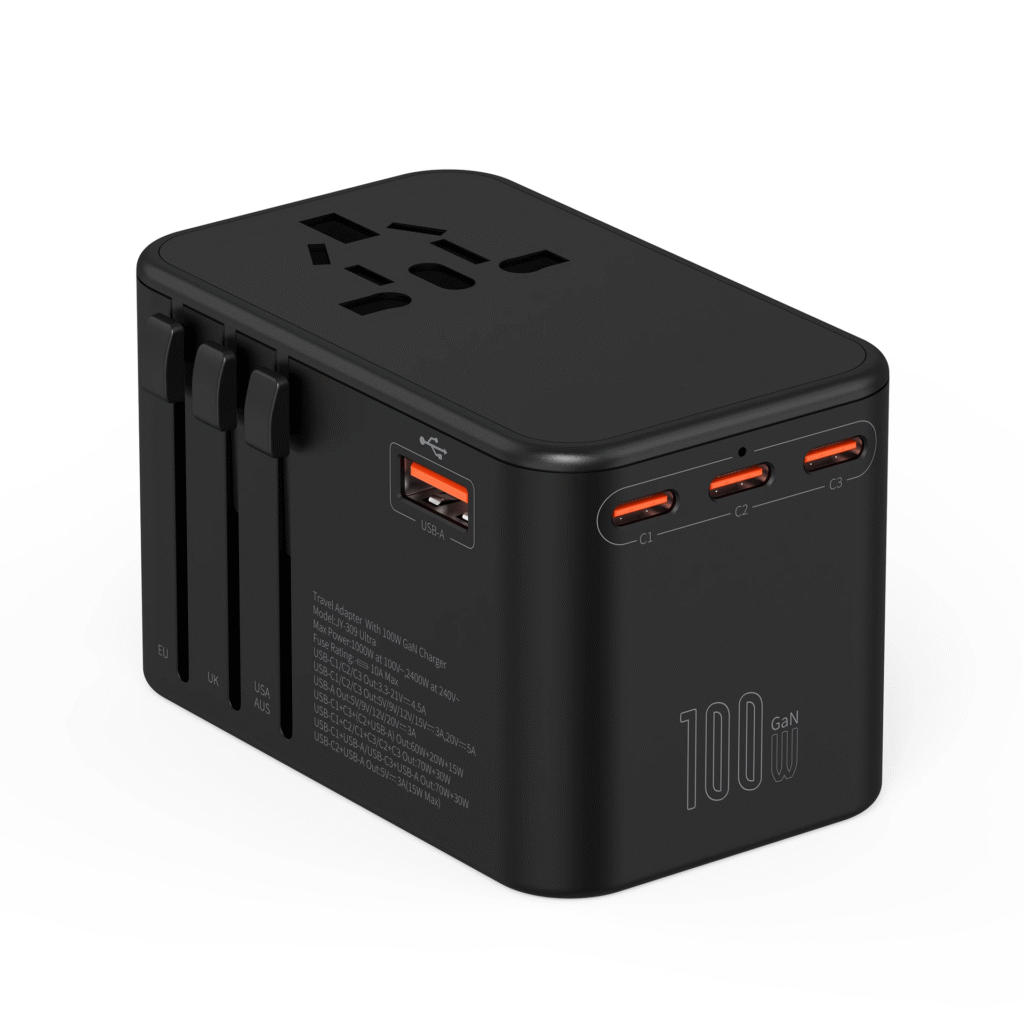
Family grouping: which wattage and plug variants can share a report
Family grouping is a technical decision, not a catalogue convenience. A representative model and a model-difference table have to show what is identical and what is not: enclosure, insulation, transformer or GaN stage, port map, and firmware that affects safety. A 65 W two-port unit and a 140 W desktop station will rarely be the same family just because they share a brand name.
Plug variants can sometimes be treated as options of one construction; they can also be national-difference items that need their own evidence. The issuing NCB decides what may share a report. Ask for the difference table before you agree that “all SKUs are covered.” The GaN charger manufacturing notes may help you describe a platform; they do not replace the NCB’s grouping rules.
How wireless chargers and PD firmware sit at the edge of a CB plan
A CB safety report for a wireless charger or a USB-C PD wall charger covers the safety standard named on the certificate. It does not, by itself, cover USB-IF protocol certification, wireless power-profile certification, or radio and EMC work that a wireless product may also need. PD firmware that changes after the safety sample is locked can be a safety issue, a protocol issue, or both.
Put firmware and wireless-protocol work on the same program timeline as the CB samples, but in their own columns. If a supplier says a wireless charger is “already covered by CB,” ask which standard, which edition, and which radio or protocol files are still open. Do not invent additional standard numbers here; name them only from the NCB’s scope and the current official list.
Turning a CB report into a national filing without starting from zero
The practical use of a CB file is to give a recognizing NCB a test record it can accept, so the national procedure does not repeat every safety test. The national filing still has its own application, markings, factory information and, often, additional differences or local tests.
Before you instruct a factory to “use the CB for country X,” confirm that the recognizing NCB is a participant for that standard, that the edition matches what the country currently requires, and that the differences you need are in the report or will be added by amendment. Then file. The CB PDF is the starting pack, not the finished national certificate. Work of this kind sits naturally with a charger compliance and certification plan, alongside the national list itself.
Document control: amendments, factory relocations and “representative models”
A CB file is a controlled document. A factory relocation, a change of legal name, a new representative model, or a safety-relevant component change is a reason to amend or to re-issue, not a reason to keep using the old PDF. IECEE’s own FAQ states that a CB Test Certificate remains valid as long as the certified products continue to conform to the initial certification, unless it is cancelled.
That sentence is a condition, not a comfort. If production no longer matches the representative model, the certificate’s usefulness is already in question. Ask who holds the certificate, who may request an amendment, and how a relocation will be notified, before you depend on the file for a second market.
A buyer checklist for reviewing a CB PDF in under an hour
A buyer does not need to re-perform the tests to review a CB PDF. In an hour, the following can be checked against the product that will actually ship.
| Check | What to match |
|---|---|
| Applicant and factory names | The legal entities on the purchase contract and on the rating label |
| Standard and edition | The edition the target market will accept at the time of filing |
| Model and difference table | The SKU, wattage, ports and plugs that will ship |
| National differences listed | The markets in the current plan, not a market added later by email |
| Photographs and ratings | The housing, label and electrical ratings of the locked sample |
| Certificate number | A public extract, where available, in the IECEE certificates database |
If any of those rows fails, the report may still be useful as a starting file, but it is not ready to be described as covering the shipping SKU. The due-diligence checklist for choosing a charger supplier can sit beside this review for the rest of the commercial file.

Where CB does not replace USB-IF, FCC, energy or wireless-protocol work
The CB Scheme is a safety mutual-acceptance system. It does not replace USB-IF certification, United States equipment authorization, energy-efficiency rules for external power supplies, or wireless-protocol certification. Those files have their own applicants, samples and change-control rules.
For energy, the European Union now has a later eco-design regulation for external power supplies, Commission Regulation (EU) 2025/2052, which repeals the earlier 2019/1782 framework from its own application date; the United States has a separate DOE external power supply page. A CB safety report should not be cited as evidence for those regimes. Keep a column in the program plan for each of them, and do not let a complete CB PDF create the impression that the other columns are done.
Planning the sequence of markets so samples and fees stay manageable
The point of a CB-centred plan is to build one well-chosen safety file and then file markets in a sequence that reuses it. That only works if the first report already contains the differences the early markets need, and if the sample set is large enough for later witnesses without being rebuilt from scratch.
Sequence by readiness, not by optimism: first the markets whose differences are already in the report and whose recognizing NCBs are confirmed, then markets that need an amendment, then markets that may not use CB at all. This page will not invent typical fees or lead times. What it can say is that each extra difference, each extra plug and each extra representative model is a sample and a fee you should see on a plan before tooling is treated as finished. A charger OEM or ODM discussion can take that sequence as the starting brief.
Conclusion
The IECEE CB Scheme gives a charger program a shared safety file, not a finished multi-market approval. The useful plan names the NCB, the standard edition, the differences, the family grouping and the sequence of national filings, and it keeps USB-IF, energy and wireless work in separate columns. A CB PDF that cannot be matched to the shipping SKU is not yet a plan.
If your team is planning a multi-market charger certification around a CB Test Report, you can send the intended markets, wattage family and plug set to WECENT through the charger compliance and certification page. This is a request for a project discussion, not an order.
FAQ
What is a CB certificate?
Under the IECEE CB Scheme, the instrument a buyer should ask for is a CB Test Certificate, issued by a participating National Certification Body together with a CB Test Report. It records that samples of a named product were tested against a published IEC standard and, where included, declared national differences. It is not a CE marking and not a national approval by itself. Participating NCBs are expected to recognize a valid certificate and report for use in their own national schemes; the national mark or registration still has to be obtained under those schemes' rules.
What does "IECEE certificate" stand for?
IECEE is the IEC System for Conformity Assessment Schemes for Electrotechnical Equipment and Components. People sometimes say "IECEE certificate" as shorthand; the document issued under the CB Scheme is a CB Test Certificate from an NCB, not a generic certificate issued by the IEC itself. IECEE operates the multilateral system for mutual acceptance of test reports and certificates. If a supplier offers an "IECEE certificate" without naming the issuing NCB, the standard edition and the report number, ask for those identifiers and check the public extract in the IECEE certificates database.
What does IEC certification mean?
There is no single global "IEC certification" mark that clears every market. IEC publishes international standards; the IECEE CB Scheme is a conformity-assessment system that uses those standards as the basis for CB Test Certificates and reports. National marks, EU CE marking and other regulatory marks are separate instruments. A buyer who is told a charger has "IEC certification" should ask which IEC standard and edition, which NCB issued the CB documents, and which national procedures still remain.
How to get IEC certification?
If the intent is multi-market safety acceptance for a charger, the practical path is to apply to a participating National Certification Body for a CB Test Certificate and CB Test Report against the agreed IEC standard edition, including relevant national differences, then use those documents in national filings. There is no single IEC office that issues a universal product certificate. The issuing NCB, the standard edition and the product family grouping should be chosen before samples are built, because those choices determine what later markets can take from the report.