
iPhone Chargers
Apple publishes the number. Buy against that, not against the box.
This is the starting point for every iPhone charging decision. Work down through the wattage each generation draws, the wireless layer, and the launch questions a brand has to answer before the phone is even public.
- Three routes below cover every iPhone charging decision
- 41 guides organised by the question they answer
- Every route ends at a wattage tier and a cable standard
Three routes, and you only need one of them
The wattage question, the iPad-charger question and the launch question have almost nothing in common. Start with the one you actually have.
Find the wattage for the model
Apple states a fast-charge requirement per family, and the phone hits it early in the charge, then tapers. That curve — not the brick — is the limit above roughly 30W.
Decide whether an iPad charger is safe
Yes, and the phone negotiates what it needs. The confusion survives because the devices look interchangeable and the cables are not always. Answering it well removes a support ticket and a review complaint at the same time.
Plan a launch or build a line
The accessory that sells is the one on the shelf in the first weeks. That means committing to a platform, packaging and compliance before the final hardware is public.
- Planning for a split launch cycle
- A launch-ready USB-C line
- Building the accessory line
- A private-label flagship line
- Best fast chargers for iPhone
- Wireless chargers for iPhone 13 Pro Max
- Chargers for iPhone 17 Pro Max
- Best GaN chargers for iPhone
For a third-party accessory range, review wholesale USB-C chargers for iPhone and confirm the intended phones and cables before sampling.
Wireless is where the real difference lives
Magnetic alignment solved the practical problem with wireless charging. Qi2 and MagSafe are where the usable speed now sits, because a misaligned pad delivers a fraction of its rating.
Which iPhones charge wirelessly
The list runs from iPhone 8 forward, but the speed depends on the generation, the pad and the alignment. Publishing the list and the caveats together is what stops a customer returning a pad that was never going to hit its claim on their phone.
MagSafe and Qi2 buying decisions
Capacity, heat and alignment decide whether a magnetic accessory is useful. A battery pack that throttles in a pocket and a car mount that vents badly are the same design failure seen in two products.
Apple Watch behaves differently
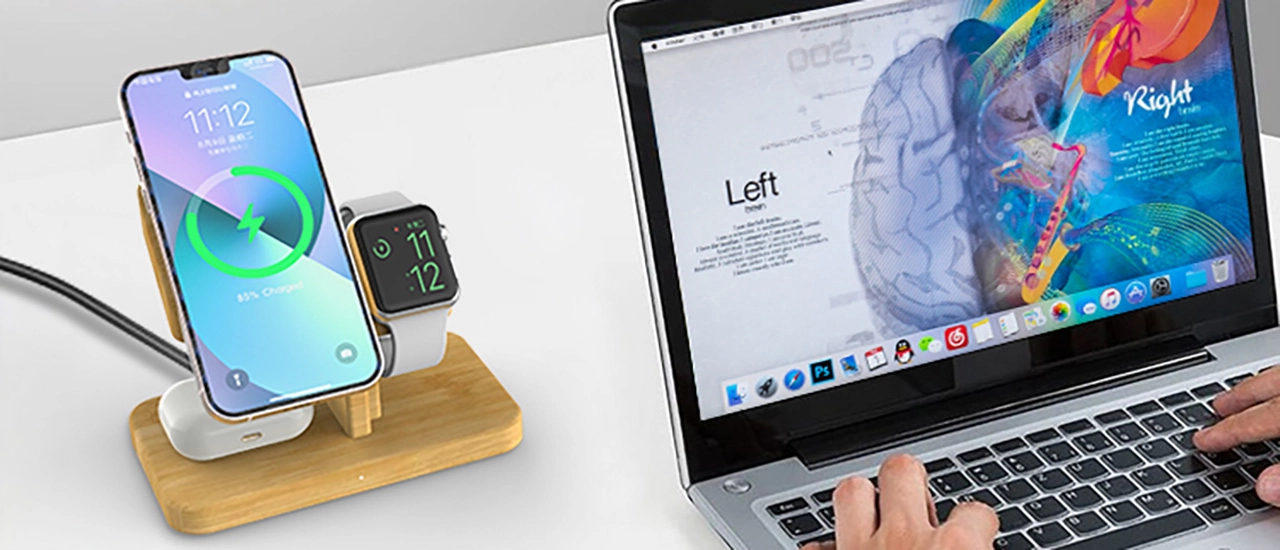
The watch puck is a licensed, tightly specified part, and a station that accepts a puck is not automatically a station that fast-charges.
Fast charging is a specification
If a product claims fast charging on the watch spot, the claim has to be traceable to the module inside. Most 3-in-1 stations do not meet it, and the difference is measurable.
Travel versions trade speed for packability
That is a legitimate choice as long as the listing says so. The buyers who complain are the ones who assumed the travel version kept the fast-charge path.
Diagnosing a slow charge
Most slow-charging complaints are a cable, a port or a profile, in that order. Diagnosing in the wrong order wastes everyone time.
The order that works
Cable, then port, then adapter, then the negotiated profile, and only then the phone. It is worth publishing because it converts a warranty claim into a support answer, and the cable is the part customers most often substitute for a cheaper one that silently caps the current.
Bundles, SKUs and mixed households
One charger that covers an iPhone and an Android is worth more than two that each cover one. Households are mixed, and bundles move the average order value.
Wholesale and gift sets
Bundles sell better than single units but multiply the compliance and packaging work. For distributors the question is which bundle earns shelf space and how it replenishes, and differentiation is what separates a wholesale line from a commodity listing.
What actually decides how fast an iPhone charges
Four things, in this order. The wattage printed on the brick is the least interesting of them.
The charge curve, not the brick
An iPhone accepts high power early and tapers. Above roughly 30W the brick stops being the constraint, which is why a 30W and a 65W unit finish the phone at nearly the same time.
The cable and connector generation
USB-C to USB-C, USB-C to Lightning or an older USB-A cable each set a different ceiling. The cable is the component most often swapped for one that silently caps the current.
Alignment on wireless
A misaligned Qi pad delivers a fraction of its rating and generates heat. Magnetic alignment is what makes a 15W claim reproducible by customers.
Thermal behaviour
Heat is the reason a phone slows down mid-charge, and it is the reason a cheap pad or a badly vented car mount never reaches its headline number.
Where to go from here
The iPhone cluster connects to four neighbours. Pick the one that matches your next question.
iPhone charger questions
The short answers. Each one links into the guide that covers it properly.
What wattage charger does an iPhone need?
Apple fast-charging starts at 20W and current generations are satisfied at 20W to 30W. Higher-wattage adapters are safe and useful when a tablet or laptop shares the port, but they do not make the phone charge faster once the curve tapers.
Will a 65W charger damage my iPhone?
No. The phone negotiates the voltage and current it wants and the adapter supplies no more than that. A higher-rated charger runs cooler and, in a multi-device household, replaces three single-purpose bricks.
Do I need a special cable for iPhone fast charging?
Yes. Modern iPhones fast-charge over USB-C to USB-C or USB-C to Lightning at the right rating, and an under-rated cable caps the current regardless of the adapter. On legacy iPhones the Lightning end matters as much as the source end.
Is MagSafe faster than a normal Qi pad on iPhone?
Usually, because magnetic alignment keeps the coils matched and the thermal behaviour predictable. A poorly aligned Qi pad can deliver a fraction of its rated power, which is why alignment — not the wattage figure — predicts the experience.
What should a brand stock for an iPhone launch?
A 20W-and-up PD line on a fixed plug platform, a magnetic wireless option, a bundle, and the compliance set for the markets served. Commit before the launch date, because the first weeks on shelf decide the SKU cycle.
Request an iPhone charger review
Send us the model list and the markets you sell into. We will come back with the wattage tier each device needs, the cable standard that supports it, and the SKUs that cover a mixed household without carrying three of the same thing.