
GaN Charger Market: What Is Shifting and What Brand Buyers Should Plan For
GaN Charger Market: What Is Shifting and What Brand Buyers Should Plan For
GaN charger market overview for brand buyers: where GaN is expected, where it earns a premium, platform overlap, component supply and US/Canada compliance.
Last updated:
This guide is part of our GaN Charger Technology. Read the full topic guide for the decisions that come before and after this step.
The GaN charger market has moved from a premium niche to a mainstream choice for compact multi-port and laptop chargers. For brand buyers, the useful questions are not about market size but about what is shifting: where GaN is now expected, where it still earns a premium, how platforms spread, and how component supply affects a programme.
This overview is written for wholesalers, distributors and brand owners planning a GaN range. It deliberately contains no market-size, growth-rate or share figures; we have not verified any that we would be willing to publish. Buyers looking at the UK, China or other regional markets will find the same planning questions apply, but regional statistics are outside the scope of this page, and the compliance notes below cover the United States and Canada only.
Shift 1: where GaN is now expected
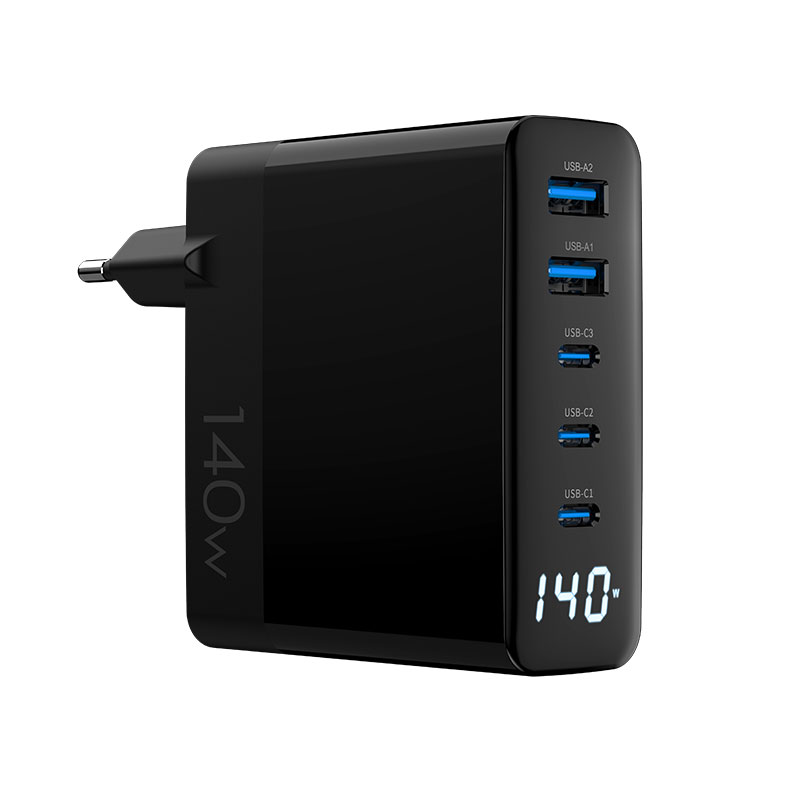
In compact, higher-power chargers, especially multi-port and laptop-capable models, buyers increasingly assume a GaN design because it allows a smaller enclosure at a given rating. At the low-power end, conventional silicon designs remain common and often make more sense on cost. A programme should decide by tier rather than adopting GaN across the whole range. Background: GaN vs silicon chargers.
Shift 2: where GaN still commands a premium
The premium has moved from “GaN” as a word to what the product does with it: size at a given output, a documented power-sharing rule, a held output under sustained load and a clean thermal result. A GaN charger without those proof points competes on price with every other GaN charger.
Shift 3: how platforms spread
Most GaN chargers are built on a limited number of controller and switching-stage platforms that many factories adopt. That shortens development time but also means competing products can be very similar inside. Differentiation comes from the enclosure, the port layout, the sharing rule, the cable and the documentation, not from the platform alone.
Shift 4: what component supply allows
Because the switching stage is central to a GaN design, a substitution during a supply shortage is a product change, not a purchasing detail. A substituted part can move the thermal result and the protection behaviour. Ask the factory how substitutions are approved and notified, and whether a substitution triggers a re-test. More: second-source component policy.
| What to watch | Why it matters to a brand | What to ask the factory |
|---|---|---|
| Tier fit | GaN is not the best answer for every wattage | Which tiers you recommend GaN for, and why |
| Proof points | The premium depends on evidence, not the label | Thermal, sharing and held-output results per model |
| Platform overlap | Competing products may share the same platform | What is specific to our model |
| Component substitution | Can change thermal and protection behaviour | How substitutions are approved, notified and re-tested |
| US / Canada file | Retail and marketplace channels ask for it early | Which reports exist for the exact model |
Compliance planning for the United States and Canada
A GaN charger is assessed like any other external charger: electrical safety evaluation by a recognised laboratory, US FCC equipment rules and Canada’s ISED interference-causing equipment standards, energy-efficiency rules where they apply, and correct labelling. Being GaN does not change which rules apply, but a new enclosure, port layout or component substitution can require the file to be updated. See selling chargers in the US and selling chargers in Canada.
Where GaN programmes go wrong
- Moving the whole range to GaN instead of choosing the tiers where it pays.
- Marketing size and wattage while leaving power sharing and derating undocumented.
- Accepting component substitutions without a re-test.
- Planning compliance after packaging artwork is finished.
FAQ
Is GaN now standard for every charger?
No. It is increasingly expected in compact higher-power and multi-port models. At lower power, silicon designs remain common and can be the better commercial choice.
Can you share GaN charger market size figures?
We do not publish market-size, growth or share figures on this page because we have not verified them. Use a named research source if you need them for a business case, and treat them as estimates.
Does the UK or China market change what a brand should specify?
The planning questions on this page apply in any market. Compliance requirements differ by country; this page covers only the United States and Canada.
What is the biggest supply risk for a GaN programme?
Uncontrolled component substitution in the switching stage. Agree how substitutions are approved and re-tested before the first order.
Next step
Send your planned tiers, port layouts and target markets (US, Canada or both) to Wecent Group through the contact page. We reply with which tiers we would build on GaN, the evidence available per model and the substitution policy for the platform. Related guides: GaN charger technology, GaN charger manufacturer, GaN charger design and wireless charger market. External references: USB-IF: USB Charger (USB Power Delivery), US FCC Part 15 rules (eCFR), ISED Canada interference-causing equipment standards.