
A device OEM deciding on a 20W GaN charger — or a 25W, 30W or 35W sibling — is not choosing four unrelated gadgets. The useful decision path is: which wattages belong in one entry family, which SKU goes in the device box and which goes on a retail hook, and which port map and protocol set the phone line actually needs. Entry wattage is a platform, not a leftover of a 65W catalog.
iPhone-specific wattage already has its own pages on this site, including the iPhone 15 charger wattage guide; this article links those guides and does not repeat them. Everyday-tier explanation for 20W and 30W as consumer concepts is on a separate everyday-tier article. What follows is the OEM-platform path for device and entry-retail buyers. See also phone chargers and USB-C PD and PPS.
20W, 25W, 30W and 35W as an entry family, not four unrelated SKUs
A 20W GaN charger sits in an entry OEM family with 25W, 30W and 35W siblings when they share a housing language, a port philosophy and a certification plan, and differ by a published PDO set. Treating them as four unrelated SKUs wastes tooling; treating them as identical hides real electrical differences.
The decision path starts with the phone line’s requested contracts. A brand that ships a 20W PD phone and a 25W PPS Android model in the same year may need two ratings, or one 25W or 30W SKU that honestly covers both, if the published PDOs and the hosts allow it. 35W is still an entry rating, useful as a mixed-catalog ceiling, not as a silent substitute for 45W or 65W laptop coverage. Freeze the family on one page of an RFQ: ratings, port maps, colours and which SKUs share a report family.
In-box versus retail-entry roles, and why cosmetics and cost targets differ
An in-box charger is part of a device’s unboxing and, in many contracts, part of the device’s compliance story. Cosmetics, print on the housing, and the cable that sits next to the brick are frozen against the device, not against a charger catalog. Cost targets are tight because the brick is often given away with the phone. A retail-entry SKU of the same wattage can carry a more visible brand treatment, a hang-sell carton and a slightly different cable kit, and it is allowed to look like a product rather than like a spare.
Do not assume the two roles can share every cosmetic tool and every cost line. A logo that is acceptable on a retail hook may be forbidden in a carrier’s in-box specification. A cheaper USB-C receptacle that passes a short retail sample may fail an in-box endurance clause. Write the two roles as two columns on the same platform sheet, and only merge them where both columns agree.
Android in-box defaults and PPS: what must be on the specification
For Android in-box programs, Programmable Power Supply (PPS) is often the difference between “it charges” and “it charges at the rate the phone was advertised.” PPS support is model-dependent. The specification must say whether PPS is required, over what voltage and current range, and on which port. A 25W or 30W nameplate without a PPS range is incomplete if the phone’s fast-charge path is a PPS path.
Also freeze USB PD revision claims, the single-port PDO set, and any vendor-specific fast-charge protocol only if the phone needs it and the factory can evidence it. Do not sprinkle protocol logos on an in-box brick as decoration. The sample plan should include a charge trace on the actual phone model, with the in-box cable, not only a generic PD tester screenshot.
iPhone wattage is already covered on existing pages — this article links, and does not repeat, those guides
Questions such as what an iPhone 15 actually draws, or how wattage tiers differ across iPhone models, are already answered on existing pages, including the iPhone 15 charger wattage guide. This article will not restate those figures and will not invent a “recommended” iPhone charger. An OEM who is putting a 20W or 30W USB-C brick in a box for an iPhone-class host should read those guides, then come back here to write the in-box platform: cosmetics, PPS or PD-only, single-C versus 1A1C, and the certification family.
Where a region no longer requires a charger in the device carton, the retail-entry 20W–35W SKU becomes the accessory the user buys separately. That is a program decision, not a wattage decision, and it should be aligned with the market’s common-charger rules rather than with a global default.
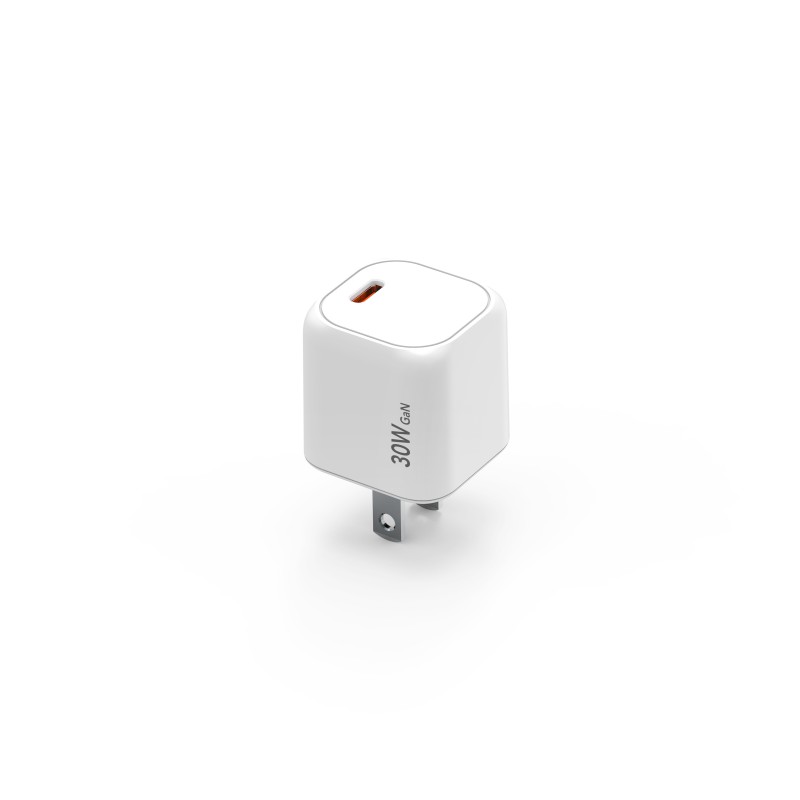
Single-C versus 1A1C at entry wattage, and EU-mandate implications
A single USB-C port is the straightforward in-box default, especially for a phone that is itself USB-C. A 1A1C (USB-A plus USB-C) map is still common on retail-entry SKUs, but it has two consequences. First, the USB-A port consumes budget and must be described honestly at simultaneous load. Second, in the European Union, Directive (EU) 2022/2380 is the common-charger framework for the device categories it lists; buyers should read the official directive text and USB-IF’s EU Conformity to USB-IF Specifications (IEC 62680) page for the USB-C side, and should not assume the directive either forbids or requires a USB-A port on an accessory brick. The legal reading of in-box offers is a separate compliance article; this page only flags that the port map has a regulatory context in the EU and must be decided before tooling.
Outside those rules, the choice is commercial: 1A1C helps a user who still has USB-A accessories; single-C is cleaner to certify and to explain at 20W–35W.
Using 20W–35W catalog models after checking live product pages
WECENT’s catalog includes a WET94 series covering 20W, 25W, 30W and 35W USB-C PD GaN wall chargers, a dual-port 20W/25W/30W 1C+1A family, and dedicated 20W, 25W and 35W GaN models with EU, UK, US and AUS plug options. After a live-page check, those models are examples of an entry family and of the single-C versus 1A1C fork. They are not a pre-approved in-box list.
Read each page for the published rating, port map and PDO set. PPS, in particular, should be taken from the current specification of the SKU that will ship, not inferred from a series name. This article does not assert certifications, MOQ or lead times for those models. The GaN charger category is the place to browse forms; the RFQ is the place to freeze one.

Certification leverage: when entry SKUs can share a report family
Entry SKUs feel certification cost sharply, so buyers reasonably ask whether 20W, 25W, 30W and 35W can share a report family. Sometimes a safety laboratory will treat closely related ratings under one construction file, with defined differences. That is a laboratory and scheme question, not a marketing assumption. Plug variants, port maps (single-C versus 1A1C) and PPS ranges are the usual reasons a “family” has to split.
USB-IF listings, if used, are product-specific under the USB-IF Compliance Program, with logo rights under a Trademark License Agreement and a check against the certified product list. A 30W listing does not automatically cover a 20W cosmetic twin. USB PD itself is described on USB-IF’s USB Charger (USB Power Delivery) page; the in-box PDO set still has to be the SKU’s published set. Plan leverage where the scheme allows it, and budget a second filing where the port map or the rating actually changes.
Quality risks of over-cheapening the entry brick: connectors, capacitors, housings
The entry brick is where cost pressure most often lands on parts the user never sees until they fail: the USB-C receptacle, electrolytic capacitors, and a housing that cracks at the plug root. An in-box program should set endurance and appearance criteria that survive a year of daily insertion, not only a first-article photograph. A cheaper receptacle that loosens, or a capacitor specified below the thermal rise of a 30W load in a 20W-sized cube, becomes a device-brand return, not a charger-catalog return.
Write those risks as tests: insertion cycles, plug-strain, case temperature at the published load, and a construction review of the parts that were reduced against the qualification sample. GaN charger manufacturing practice is context for an audit; it does not replace those tests.
Forecast mix: how many entry SKUs a new brand actually needs
A new brand rarely needs all four ratings at launch. A typical honest mix is one in-box default (often 20W or 25W, driven by the phone) and one retail-entry SKU that may be the same rating in a different carton, or one step up (30W or 35W) if the retail hook has to look like an upgrade. A 1A1C retail SKU and a single-C in-box SKU may be justified; four colours times four ratings at day one usually are not.
Do not invent a standard mix or a standard MOQ. Build the mix from the phone SKUs, the markets, and the number of cartons the brand can actually manage in the first season.
A specification template for a 20–35W OEM platform
| Block | What to freeze | What not to leave implicit |
|---|---|---|
| Rating family | Which of 20W, 25W, 30W, 35W will ship, and which share a housing | That a series name makes the PDO sets identical |
| Role | In-box, retail-entry, or both, with cosmetic differences named | That one artwork serves a carrier in-box and a hang-sell carton |
| Port and protocol | Single-C or 1A1C; PD and, if required, PPS range | PPS support inferred from a 25W nameplate |
| Cable and plug | Controlled cable SKU; plug family and markets | A random USB-C cable as an equivalent spare |
| Evidence | Safety and EMC path; USB-IF only if a logo or claim requires it | A sibling’s report as automatic cover |
That template is enough to quote a platform. It is also enough to stop a 20W in-box program and a 35W retail SKU from drifting into two unrelated quality stories.
Conclusion
20W, 25W, 30W and 35W work as an OEM entry family when ratings, port maps and roles are frozen together, and when iPhone wattage questions are answered by linking existing guides rather than by rewriting them. Keep PPS and EU port-map implications on the specification, and do not cheapen the receptacle and the capacitors that an in-box brick will live on.
If you are specifying a 20W–35W in-box or retail-entry charger platform, you can send the intended phone models, port map and markets to WECENT through the GaN charger manufacturing page. This is a request for a sourcing discussion, a quotation or a sample plan, not an order.
FAQ
Is the iPhone charger 20 W?
It depends on the iPhone model, the region, and whether a charger is included in the box at all. Apple has sold a 20W USB-C power adapter as a common accessory, and some iPhone models negotiate a 20W-class USB PD contract, but other adapters and other models use different ratings. This article does not repeat those model-by-model figures; they are covered on existing wattage guides, including the iPhone 15 charger wattage page on this site. For an OEM in-box program, take the host’s requested contract from the device documentation and specify the brick to that contract, rather than assuming “the iPhone charger” is always 20W.
Is it safe to use a GaN charger?
Safety is a property of a finished, certified product, not of the word “GaN.” Gallium nitride is a semiconductor used in many compact adapters. A 20W–35W GaN charger is appropriate to use when it has the safety and EMC filings required in the market of sale, when its published rating matches the phone, and when it is used with a suitable cable. A GaN label does not replace a report, and it does not make a damaged or unlisted adapter acceptable. Ask for the safety-report identity of the exact SKU that will ship in the box.
What is the most recommended iPhone charger?
There is no single recommended iPhone charger for every model and every OEM program, and this page will not rank retail products. The right rating is the one that matches what the specific iPhone negotiates, as described in the device documentation and in the existing iPhone wattage guides on this site. An in-box or retail-entry OEM SKU should be specified to that contract, with a controlled cable and the required filings, rather than chosen from a “best charger” list. A higher wattage is not automatically a better recommendation if the phone will not request it.
Is 5V equal to 20W?
No. 5V is a voltage; 20W is a power. Power in watts is voltage multiplied by current, so 20W at 5V would require 4A, which is not how a typical 20W USB Power Delivery phone contract is written. A 20W USB-C charger usually reaches 20W at a higher PD voltage (commonly a 9V-class contract) with a current in the range published on the PDO set. Reading a “5V” marking on a port or a cable as “20W” is a category error. Specify both the voltage and the current, or the wattage and the PDO list, and do not treat 5V and 20W as interchangeable labels.
{
“@context”: “https://schema.org”,
“@type”: “FAQPage”,
“mainEntity”: [
{
“@type”: “Question”,
“name”: “Is the iPhone charger 20 W?”,
“acceptedAnswer”: {
“@type”: “Answer”,
“text”: “It depends on the iPhone model, the region, and whether a charger is included in the box at all. Apple has sold a 20W USB-C power adapter as a common accessory, and some iPhone models negotiate a 20W-class USB PD contract, but other adapters and other models use different ratings. This article does not repeat those model-by-model figures; they are covered on existing wattage guides, including the iPhone 15 charger wattage page on this site. For an OEM in-box program, take the host’s requested contract from the device documentation and specify the brick to that contract, rather than assuming “the iPhone charger” is always 20W.”
}
},
{
“@type”: “Question”,
“name”: “Is it safe to use a GaN charger?”,
“acceptedAnswer”: {
“@type”: “Answer”,
“text”: “Safety is a property of a finished, certified product, not of the word “GaN.” Gallium nitride is a semiconductor used in many compact adapters. A 20W–35W GaN charger is appropriate to use when it has the safety and EMC filings required in the market of sale, when its published rating matches the phone, and when it is used with a suitable cable. A GaN label does not replace a report, and it does not make a damaged or unlisted adapter acceptable. Ask for the safety-report identity of the exact SKU that will ship in the box.”
}
},
{
“@type”: “Question”,
“name”: “What is the most recommended iPhone charger?”,
“acceptedAnswer”: {
“@type”: “Answer”,
“text”: “There is no single recommended iPhone charger for every model and every OEM program, and this page will not rank retail products. The right rating is the one that matches what the specific iPhone negotiates, as described in the device documentation and in the existing iPhone wattage guides on this site. An in-box or retail-entry OEM SKU should be specified to that contract, with a controlled cable and the required filings, rather than chosen from a “best charger” list. A higher wattage is not automatically a better recommendation if the phone will not request it.”
}
},
{
“@type”: “Question”,
“name”: “Is 5V equal to 20W?”,
“acceptedAnswer”: {
“@type”: “Answer”,
“text”: “No. 5V is a voltage; 20W is a power. Power in watts is voltage multiplied by current, so 20W at 5V would require 4A, which is not how a typical 20W USB Power Delivery phone contract is written. A 20W USB-C charger usually reaches 20W at a higher PD voltage (commonly a 9V-class contract) with a current in the range published on the PDO set. Reading a “5V” marking on a port or a cable as “20W” is a category error. Specify both the voltage and the current, or the wattage and the PDO list, and do not treat 5V and 20W as interchangeable labels.”
}
}
]
}