
A wireless OEM catalog is stronger when a pad, a stand and a foldable are a platform family, not three isolated SKUs with three magnet specs, three finishes and three manuals. The choice is a use-case and tooling decision, not a search for a single best form. This page is a comparison sheet for engineers and catalog managers who have to pick the first two forms in a line. It will not rank a winner.
Context sits in wireless charging, wireless charger OEM and ODM, and private-label wireless charger launch.
Pad, stand and foldable as a platform family, not three isolated SKUs
A pad, a stand and a foldable should be planned as one platform family, with shared modules the factory can show, a shared finish, and consistent manuals. Three isolated SKUs will drift on magnets and after-sales. The first decision is whether the family is one architecture, not which form looks best in a photograph.
Qi2 or other certification work, where it applies, should be planned against that architecture. See Qi2 certification and selection for the listing path; this page is the form-factor choice that sits beside it.
Use-case mapping: travel, nightstand, desk and gift
Map forms to use cases before drawing a first housing. A thin pad favours travel and a bag. A stand favours a nightstand or a desk, where a phone must stay visible. A foldable 3-in-1 favours a gift channel and a travel kit that must also take a watch and earbuds, at the cost of a hinge. A brand that launches all three without that map will split forecast and confuse a retailer’s shelf. Write the intended use on the RFQ, then choose the forms.
Tooling and coil-module overlap a buyer can ask a factory to show
Ask the factory to show which coil and magnet modules are shared, which housings need a new tool, and which jigs are unique. A shared module is a genuine saving only when the shared scope is written down. A foldable frame is usually a new mechanical tool even when the phone coil is shared with a pad. The existing-mould path is discussed in launching a custom wireless product from an existing mold; this page only requires that the overlap be visible, not assumed.
Certification leverage and where a form-factor change breaks a report family
A form-factor change can break a Qi report family and a safety report family for different reasons. Official Qi certification process language lives on the WPC Qi certification process page and in the Qi wireless charging standard overview; a trademark-licence question is on WPC’s trademark licenses page. Safety-report family questions sit with the standard named in your project and with a body in the IECEE CB Scheme. USB logo or TID questions, where a cable or a charger in the same kit needs them, are described on USB-IF compliance and in the USB-IF document library. None of those pages invents a form-factor exemption for a pad, a stand or a foldable.
A form-factor change can break a report family. A new hinge, a new coil-to-housing distance, or a new metal part can require a new Qi or safety evaluation even when the coil module is the same. Ask, for each form, which reports are shared and which must be new. Do not assume a pad listing covers a foldable, and do not invent a leverage percentage. The factory fills a table; the laboratory confirms it.
Retail assortment: how many forms a new brand actually needs at launch
A new brand rarely needs every form on day one. Two forms that share a module, a finish and a manual are usually enough to test a channel: often a pad plus a stand, or a pad plus a gift foldable, depending on the map above. A third form can wait for a second purchase order, after returns and sell-through are visible. Launching three forms to look complete is how inventory and certification cost run ahead of demand.
Using catalog pads, stands and foldables as examples after a product-page check
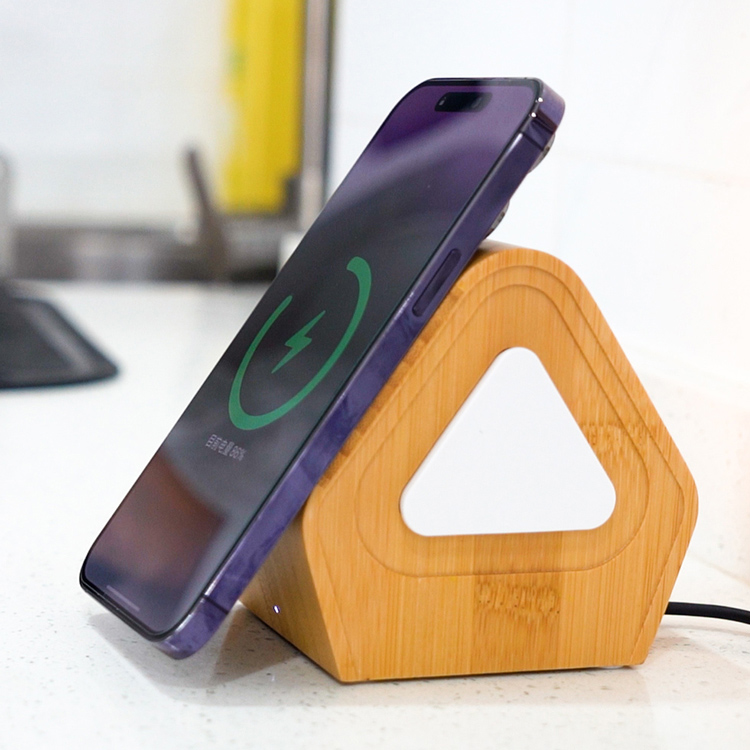
Use catalog models only after reading the live product page. The WEG-2201 page, as opened for this article, presents a 3-in-1 bamboo housing with published outputs of 15 W for a phone, 5 W for earbuds and 2 W for a watch, a size of 103 × 75 × 101 mm, and an input line of 9 V/2.22 A and 12 V/1.67 A and above (QC 3.0/PD). Those are catalog statements for a stand-like gift form. The page title uses the word MagSafe, which is an Apple trademark and is not a form-factor recommendation. Other pads and foldables in the wireless charger category should be read the same way: only with a verified page, and without a ranking.
Cost and packaging differences that a “wireless charger” headline hides
A foldable needs a hinge tool, a tighter transit pack, and often a different manual. A stand needs a stable base and a different carton footprint. A pad is usually the smallest pack. Those differences sit in NRE, packaging and after-sales, not only in the unit price. A “wireless charger” headline hides them. Put them on the comparison sheet with the module-overlap table.
A decision table for choosing the first two forms in a line
| If the primary use is… | A first form that usually fits | A second form that can share a family | What to confirm before a tool-go |
|---|---|---|---|
| Travel and a bag | A thin pad | A compact foldable, if a watch is in the kit | Shared coil module, pack size, hinge test if folded |
| Nightstand or desk | A stand | A pad for travel restock | Viewing angle, stability, shared finish and manual |
| Gift and a 3-in-1 story | A foldable or a 3-in-1 stand | A pad as a lower-price hero | Hinge or frame life, gift pack, certification scope |
When a 3-in-1 foldable replaces a pad, and when it does not
A 3-in-1 foldable replaces a pad when the channel will not sell a phone-only SKU, and when the buyer is prepared to qualify a hinge. It does not replace a pad when travel thickness, a lower unit price, or a simpler after-sales path is the point of the line. A foldable that is used as a pad — left flat, never folded — is a more expensive pad. Write the intended posture, and do not let a gift photograph make the decision.

RFQ language that keeps a family consistent on magnets, finishes and manuals
The RFQ should freeze a magnet and alignment specification for the family, a finish and colour standard, and a manual structure that only changes where the form requires it. It should ask which modules and reports are shared. It should refuse a response that quotes three forms as if they were three unrelated products with no overlap table. Consistency is a specification item, not a hope.
Conclusion
Choose a pad, a stand and a foldable as a platform family, on use-case and on shown tooling overlap, not on a search for a best form. Launch the two forms the channel actually needs, confirm where a form change breaks a report, and keep magnets, finishes and manuals consistent in the RFQ. Use catalog models only as live pages state.
If your team is choosing a wireless platform family and wants to discuss pad, stand and foldable scope, you can send that scope through the wireless charger OEM and ODM page. This is a request for a project discussion, not a ranking of forms.
FAQ
Should a new brand launch a pad, a stand and a foldable at the same time?
Only if the three forms are specified as one platform family, and only if the channel actually needs all three at launch. Shared magnet and coil modules, a shared finish, and manuals that describe the same charging behaviour should be visible in the factory’s file. Three isolated SKUs will drift, and you will then be running three programs. Many new brands are better served by two forms that cover the main use cases — for example a travel pad and a nightstand stand — with a foldable held for a second purchase order once the architecture is stable.
When does a form-factor change break a certification report family?
A change of housing, coil position, magnet map, or a new metal face can break a Qi report family even when the coil module looks the same. A safety report can break for its own reasons, including a mains adapter in the same kit. This article will not invent that boundary. Ask the factory and the certification body which form factors can share a report, and which need a new evaluation, against current WPC and IECEE process language. A photograph of three forms in one colour is not a report-family statement.
Can a 3-in-1 foldable replace a simple pad in a gift assortment?
It can, when the gift channel wants a phone, a watch and an earbud case on one object, and when you are prepared to qualify a hinge or a frame as well as a coil. It should not replace a pad when travelers want a thin object, when a hinge is not going to be tested, or when a rigid 3-in-1 frame would be a simpler gift. Use catalog pads, stands and foldables only after a product-page check, and do not rank a “best” form. The use case and the mechanical file decide.
What should an RFQ say so a pad, a stand and a foldable stay consistent?
The RFQ should name the shared magnet and coil modules the factory can actually show, a finish standard, a silk and manual rule, and a charging-behaviour description that all three forms must meet. It should also name where a form is allowed to differ — for example a hinge test on the foldable only. Ask for a module-overlap drawing, not only three photographs. Existing-mould programs still need this language, or a later colour or a later stand will quietly become a fourth program.
{
“@context”: “https://schema.org”,
“@type”: “FAQPage”,
“mainEntity”: [
{
“@type”: “Question”,
“name”: “Should a new brand launch a pad, a stand and a foldable at the same time?”,
“acceptedAnswer”: {
“@type”: “Answer”,
“text”: “Only if the three forms are specified as one platform family, and only if the channel actually needs all three at launch. Shared magnet and coil modules, a shared finish, and manuals that describe the same charging behaviour should be visible in the factory’s file. Three isolated SKUs will drift, and you will then be running three programs. Many new brands are better served by two forms that cover the main use cases — for example a travel pad and a nightstand stand — with a foldable held for a second purchase order once the architecture is stable.”
}
},
{
“@type”: “Question”,
“name”: “When does a form-factor change break a certification report family?”,
“acceptedAnswer”: {
“@type”: “Answer”,
“text”: “A change of housing, coil position, magnet map, or a new metal face can break a Qi report family even when the coil module looks the same. A safety report can break for its own reasons, including a mains adapter in the same kit. This article will not invent that boundary. Ask the factory and the certification body which form factors can share a report, and which need a new evaluation, against current WPC and IECEE process language. A photograph of three forms in one colour is not a report-family statement.”
}
},
{
“@type”: “Question”,
“name”: “Can a 3-in-1 foldable replace a simple pad in a gift assortment?”,
“acceptedAnswer”: {
“@type”: “Answer”,
“text”: “It can, when the gift channel wants a phone, a watch and an earbud case on one object, and when you are prepared to qualify a hinge or a frame as well as a coil. It should not replace a pad when travelers want a thin object, when a hinge is not going to be tested, or when a rigid 3-in-1 frame would be a simpler gift. Use catalog pads, stands and foldables only after a product-page check, and do not rank a “best” form. The use case and the mechanical file decide.”
}
},
{
“@type”: “Question”,
“name”: “What should an RFQ say so a pad, a stand and a foldable stay consistent?”,
“acceptedAnswer”: {
“@type”: “Answer”,
“text”: “The RFQ should name the shared magnet and coil modules the factory can actually show, a finish standard, a silk and manual rule, and a charging-behaviour description that all three forms must meet. It should also name where a form is allowed to differ — for example a hinge test on the foldable only. Ask for a module-overlap drawing, not only three photographs. Existing-mould programs still need this language, or a later colour or a later stand will quietly become a fourth program.”
}
}
]
}
