
The counter-intuitive fact about a wireless charger with clock that also plays music is that the extra functions are not free decorations on a Qi pad. A speaker’s amplifier and a clock’s display are electrical neighbours of a wireless coil, and they sit inside a housing that may rotate. Coexistence — whether those functions leave the Qi session, the audio and the clock all usable at once — is the specification problem. A 5-in-1 headline that ignores it becomes a return.
This page is for desktop-accessory and gift OEM buyers specifying a rotary 5-in-1. It is not a desk-station buying list; a 3-in-1 landscape piece already exists as best 3-in-1 wireless charging stations for every desk. Use this page for EMC, acoustics, rotary life and claim limits. Context is on wireless charger OEM and the Qi2 certification and selection article. The R10 5-in-1 rotary page is a catalog example, used only as published.
What a 5-in-1 rotary station is combining: Qi, clock, speaker, and sometimes a USB port
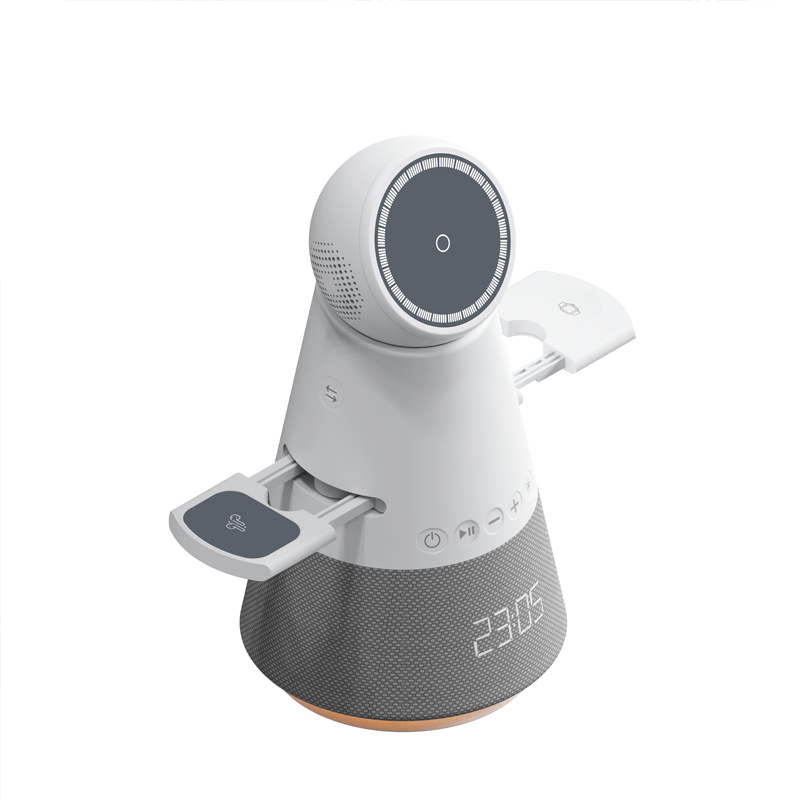
A 5-in-1 rotary station combines a Qi phone position, usually a watch and earbud position, a clock, a Bluetooth speaker, and sometimes a USB port, in a housing that can rotate. Each function needs its own evidence; the “5-in-1” count is a marketing tally, not a test result. Rotation is a mechanical function on top.
Before artwork, list the functions the SKU will actually ship, and drop any function that will not be evidenced. If the fifth item is a USB port, publish its allocation. If the fifth item is a night-light or a tray, say so, and do not let a vague “5-in-1” hide a missing test.
Coexistence: how a speaker and a clock can interfere with a wireless coil
A speaker amplifier, a Bluetooth radio, a clock display and a wireless coil share a compact enclosure and, often, a shared power path. Interference can show up as a Qi session that drops when the speaker is loud, a clock that flickers when a phone is charging, audible noise on the speaker when the coil is active, or a radio that fails a conducted or radiated EMC limit only in one combination of states. Those are coexistence problems, not three separate “quality issues.”
The sample plan should therefore run combinations: Qi on / speaker idle; Qi on / speaker playing; Qi on / clock display at night brightness; rotation while a session is active. A test that only charges a phone with the speaker off has not tested the product the carton describes.
EMC, acoustic and safety reports a buyer should see before artwork
Before artwork is approved, a buyer should see the safety report for the exact construction, an EMC report that includes the wireless, Bluetooth and display states the product will use, and an acoustic or speaker-performance record if the sell-sheet will mention sound. Ask whether the EMC report was run with the coil active and the speaker playing. A report that only covers a Qi pad in a silent housing may not represent the 5-in-1.
This article will not invent limit values from EMC standards, and it will not attach a certificate to a catalog model. The R10 product page, for example, describes a 5-in-1 rotary touch wireless charger with a Bluetooth speaker and a clock; it is a function list to be evidenced, not a substitute for those reports. Logo and Qi-identity claims follow the same rule as on the certification-selection page: only with a current listing, checked against the Wireless Power Consortium, the Qi wireless charging standard, the WPC knowledge base and the certified products database. If Qi2 25W is claimed, use the WPC’s 23 July 2025 news release for the branding fact, not as a substitute for a listing.
Rotary mechanism life and cable routing inside a moving housing
A rotary 5-in-1 has a moving joint and, inside it, cables or contacts that have to survive the rotation life the program claims. The RFQ should state a cycle count, a torque or feel check, and a repeat Qi-alignment check after cycling. Cable routing that pulls a coil off centre, or a slip-ring that becomes intermittent, will show up as “sometimes it doesn’t charge” after a month on a desk — a typical return this form factor earns when the mechanism is under-specified.
Service policy should say whether the rotary joint is a service part or a full-unit swap. Gift-channel buyers usually want the latter; either way, name it before launch.
Claim limits: clock accuracy, speaker power, and Qi wattage as separately evidenced items
Clock accuracy, speaker output and Qi (or Qi2) wattage are three claims, each with its own evidence. Do not invent a speaker wattage, a clock-accuracy figure, or a wireless power figure beyond what the current product page and the report state. If the page does not publish speaker watts, the sell-sheet should not either. If the page publishes a total charging power, ask how that total is split across positions, as in the 3-in-1 budget table.
| Claim | Evidence to request | Keep off the carton until |
|---|---|---|
| Qi / Qi2 wattage | Published per-position budget and, if claimed, WPC identity | A family total is treated as the phone-pad figure |
| Clock | What the page actually states (display, time source); any accuracy figure only from a method the factory can show | An invented “atomic” or seconds-per-month claim |
| Speaker | Bluetooth identity as published, and an acoustic record if sound is marketed | An invented wattage or “hi-fi” claim |
| Rotation | Cycle life and alignment after rotation | A photograph of a hand turning the unit |
Using R10 and R9 catalog models only as published, including the Bluetooth-speaker and clock functions
The live R10 page presents a 5-in-1 rotary touch wireless charger with a Bluetooth speaker and a clock; the R9 page presents a 3-in-1 rotary touch wireless charger without those two functions. That difference is useful for a program: R10 is the coexistence SKU, R9 is the simpler rotary dock. Use only the functions and figures those pages currently publish, and do not extend watch-year or phone-model lists into a universal promise. This article does not assert certifications, speaker watts or clock accuracy for either model.
Other 5-in-1 stations in the wireless charger category should be read the same way: function list first, then evidence, then artwork.
Desk-use and gift-use specification differences
Desk-use cares about footprint, cable exit, overnight clock brightness, and whether the speaker will be used during a working day — which makes coexistence and EMC more than a lab formality. Gift-use cares about unboxing, logo, a stable base on a hotel or bedside table, and a simple first-use path. A gift unit that needs a manual to start the clock will be left on factory default; a desk unit that glares at night will be unplugged.
Write brightness, default modes and logo decoration as specification items, and do not assume one carton serves both channels without an insert change.
Production tests: rotation cycles, Qi alignment after rotation, and off-state power
Production should include a rotation-cycle sample, a Qi seating and start-of-charge check after rotation, FOD on the coils the user can occupy, and an off-state or standby-power check if the clock and display remain on. Off-state power is easy to skip and easy to get wrong on a product that is never really off. Agree the method with the buyer; do not invent a regulatory limit here.
Failed units should be photographed in the state that failed — speaker on, coil on, joint at a stated angle — so the failure is reproducible. A “failed EMC” line without a state description is not a useful record.

Retail returns typical of multi-function desks — and how a spec can reduce them
Typical returns for this form are: “the phone stopped charging after I turned it,” “the speaker buzzes when it charges,” “the clock is wrong,” “it is too bright at night,” and “my new watch doesn’t fit.” Each of those maps to a clause already on this page: rotary alignment, coexistence, clock evidence, brightness, and watch model-year. A specification that includes those clauses, and a carton that does not over-claim them, will not eliminate returns, but it will stop the program from being surprised by them.
A support script should also say, honestly, which watch years and which phone positions were tested, rather than inviting the user to discover a gap.
When a simpler 3-in-1 is the more honest SKU
A simpler 3-in-1 — phone, watch, earbuds, no speaker, no clock — is the more honest SKU when the brand cannot evidence coexistence, when EMC of a speaker-plus-coil housing is not in the budget, when the gift buyer only wanted a dock, or when returns on multi-function desks would cost more than the speaker adds. Honesty here is a catalog decision: R9-class rotary 3-in-1 versus R10-class 5-in-1, not a bigger number on a carton.
If the speaker and clock are the reason the buyer is in the category, stay on the 5-in-1 and fund the tests. If they are a decoration on a charging dock, they are the functions to take off the drawing.
Conclusion
A 5-in-1 rotary wireless station is a coexistence product: Qi, clock and speaker in a moving housing. Evidence those functions separately, test them together, and specify rotation life and post-rotation alignment. Use R10 and R9 only as published, and choose a 3-in-1 when that is the product the brand can actually stand behind.
If you are specifying a 5-in-1 rotary wireless station for a desk or gift OEM line, you can send the intended function list and test scope to WECENT through the wireless charger OEM page. This is a request for a sourcing discussion, a quotation or a sample plan, not an order.
FAQ
Why can a Bluetooth speaker or a clock interfere with wireless charging on a 5-in-1?
Because they share a compact enclosure, a power path and, often, a board with a wireless coil and a Bluetooth radio. A speaker amplifier can couple noise into the coil path; a coil can couple into the speaker or the display; an EMC limit can be met with the speaker off and missed with the speaker on. Those are coexistence effects. A sample plan should run the combinations the carton describes — Qi on with the speaker playing, the clock at intended brightness, and rotation during a session — and an EMC report should state which of those states were included. A phone-only charge test with the speaker muted has not tested the 5-in-1.
Should clock accuracy and speaker wattage be taken from a catalog headline?
No. Clock accuracy, speaker output and Qi wattage are separate claims, each needing evidence. If the live product page does not publish a speaker wattage or a clock-accuracy figure, the sell-sheet should not invent one. If it publishes a total charging power, ask how that total is split. Use R10 and R9 only as their current pages describe them — R10 as a 5-in-1 with speaker and clock, R9 as a 3-in-1 rotary dock — and attach reports before artwork, not after a gift-channel launch.
What production tests are specific to a rotary 5-in-1 station?
A rotation-cycle sample, a Qi seating and start-of-charge check after rotation, foreign-object detection on the coils the user can occupy, and an off-state or standby check if the clock remains on. Failed units should be recorded in the state that failed, including speaker and joint angle. Mechanical feel and cable routing inside the moving housing are part of the same plan. These tests sit on top of, and do not replace, the safety and EMC reports a buyer should see before artwork.
When is a 3-in-1 a more honest OEM choice than a 5-in-1?
When the brand cannot evidence speaker-and-coil coexistence, when EMC of a multi-function housing is not in the program budget, when the buyer only needed a charging dock, or when typical multi-function returns — charging after rotation, speaker buzz, clock and brightness complaints — would outweigh the extra functions. A rotary 3-in-1 such as the R9-class dock is then the cleaner SKU. If the speaker and clock are the reason for the purchase, stay on the 5-in-1 and fund the combination tests rather than decorating a dock with untested functions.
{
“@context”: “https://schema.org”,
“@type”: “FAQPage”,
“mainEntity”: [
{
“@type”: “Question”,
“name”: “Why can a Bluetooth speaker or a clock interfere with wireless charging on a 5-in-1?”,
“acceptedAnswer”: {
“@type”: “Answer”,
“text”: “Because they share a compact enclosure, a power path and, often, a board with a wireless coil and a Bluetooth radio. A speaker amplifier can couple noise into the coil path; a coil can couple into the speaker or the display; an EMC limit can be met with the speaker off and missed with the speaker on. Those are coexistence effects. A sample plan should run the combinations the carton describes — Qi on with the speaker playing, the clock at intended brightness, and rotation during a session — and an EMC report should state which of those states were included. A phone-only charge test with the speaker muted has not tested the 5-in-1.”
}
},
{
“@type”: “Question”,
“name”: “Should clock accuracy and speaker wattage be taken from a catalog headline?”,
“acceptedAnswer”: {
“@type”: “Answer”,
“text”: “No. Clock accuracy, speaker output and Qi wattage are separate claims, each needing evidence. If the live product page does not publish a speaker wattage or a clock-accuracy figure, the sell-sheet should not invent one. If it publishes a total charging power, ask how that total is split. Use R10 and R9 only as their current pages describe them — R10 as a 5-in-1 with speaker and clock, R9 as a 3-in-1 rotary dock — and attach reports before artwork, not after a gift-channel launch.”
}
},
{
“@type”: “Question”,
“name”: “What production tests are specific to a rotary 5-in-1 station?”,
“acceptedAnswer”: {
“@type”: “Answer”,
“text”: “A rotation-cycle sample, a Qi seating and start-of-charge check after rotation, foreign-object detection on the coils the user can occupy, and an off-state or standby check if the clock remains on. Failed units should be recorded in the state that failed, including speaker and joint angle. Mechanical feel and cable routing inside the moving housing are part of the same plan. These tests sit on top of, and do not replace, the safety and EMC reports a buyer should see before artwork.”
}
},
{
“@type”: “Question”,
“name”: “When is a 3-in-1 a more honest OEM choice than a 5-in-1?”,
“acceptedAnswer”: {
“@type”: “Answer”,
“text”: “When the brand cannot evidence speaker-and-coil coexistence, when EMC of a multi-function housing is not in the program budget, when the buyer only needed a charging dock, or when typical multi-function returns — charging after rotation, speaker buzz, clock and brightness complaints — would outweigh the extra functions. A rotary 3-in-1 such as the R9-class dock is then the cleaner SKU. If the speaker and clock are the reason for the purchase, stay on the 5-in-1 and fund the combination tests rather than decorating a dock with untested functions.”
}
}
]
}
