
A 3 in 1 wireless charger OEM program is decided in the coil layout and in the watch-magnet specification, not on a gift-catalog headline. Three coils in one housing share heat, clearance and a foreign-object path; a watch puck that fitted last year’s watch may not fit this year’s. Corporate-gift packaging sits on top of that engineering, and it does not repair a layout that misses charges on the desk.
This page is for gift, retail and wireless OEM buyers who have to write those specs. It is not a consumer buying list. Category and certification context are on wireless charging, wireless charger OEM, and the Qi2 certification and selection article. The wireless charger category is the catalog browse, not the specification.
Three coils, one housing: the layout decisions that drive heat and missed charges
Three coils in one 3-in-1 housing must be placed so a phone, watch and earbud case can sit together without crowding coupling or dumping heat into one corner. Layout is a thermal and geometric decision first. A missed watch charge, or a phone that only charges when nudged, is usually a layout issue.
The RFQ should require a layout drawing with coil centres, a simultaneous-load thermal test, and a description of what happens when only one or two positions are occupied. A pretty rendering is not a layout. If the housing is foldable, the drawing has to show the coils in both the folded and the standing positions, because a hinge can move a coil off its intended seat.
Watch-magnet compatibility as a model-year problem, not a logo problem
Watch charging on a 3-in-1 is a model-year problem. Magnet geometry, puck height and the watch’s own charging requirement change across years and across brands. A logo on a sell-sheet, including an Apple Watch mention on a catalog page, is not a universal compatibility promise. The specification should name the watch models and years the SKU is intended to support, and the sample plan should include those watches — not a single undated “watch.”
When a new watch year is released, treat it as a change-controlled question: does the current puck still couple, and does the magnet still sit? Do not claim “all Apple Watch models” or “all smartwatches.” If the factory cannot name the years it has tested, the gift channel will discover the gap in December returns.
Phone, earbud and watch power budgets written as a table, not a headline
A “25W 3-in-1” or “15W 3-in-1” headline is not a specification. The RFQ needs a budget table: phone-position maximum, watch-position maximum, earbud-position maximum, and the simultaneous total when all three are occupied. Those figures must come from the live product page or from a report for the exact SKU, not from a family nickname.
| Position | What the specification states | What a headline hides |
|---|---|---|
| Phone | Published wireless wattage and, if claimed, Qi or Qi2 identity | Assuming the family total is available at the phone pad alone |
| Watch | Published wattage and the watch models/years tested | A logo in place of a model-year list |
| Earbuds | Published wattage and the case size the well will accept | A well that only fits one brand’s case |
| All three at once | Simultaneous budget and a thermal limit at that load | “Charges three devices” with no allocation |
If a catalog model publishes 15W on the phone and 5W and 3W or 5W on the other positions, write those numbers as published, and do not add them up into a marketing total that the product page does not use. If a model publishes a 25W total, ask how that total is split.
Gift-channel specs: packaging, logo, carton and a SKU that survives a desk
Gift-channel buyers care about the unboxing and about whether the unit still looks intact after a quarter on a desk. Specify packaging (gift box, sleeve, print), the logo process and its position, the language of the insert, and a cosmetic standard that includes scratch and hinge feel if the unit folds or rotates. A SKU that survives a desk also needs a stable base, a cable exit that does not lift the housing, and a surface that does not collect a ring of abrasion around the phone pad.
Corporate colours and logo decoration are part of the RFQ appendix, with artwork locked before mass production. They are not a reason to skip the simultaneous-load test. A beautifully printed unit that misses the watch charge is a gift that gets left in a drawer.
Fold versus stand versus pad — choosing a 3-in-1 form with the catalog in mind
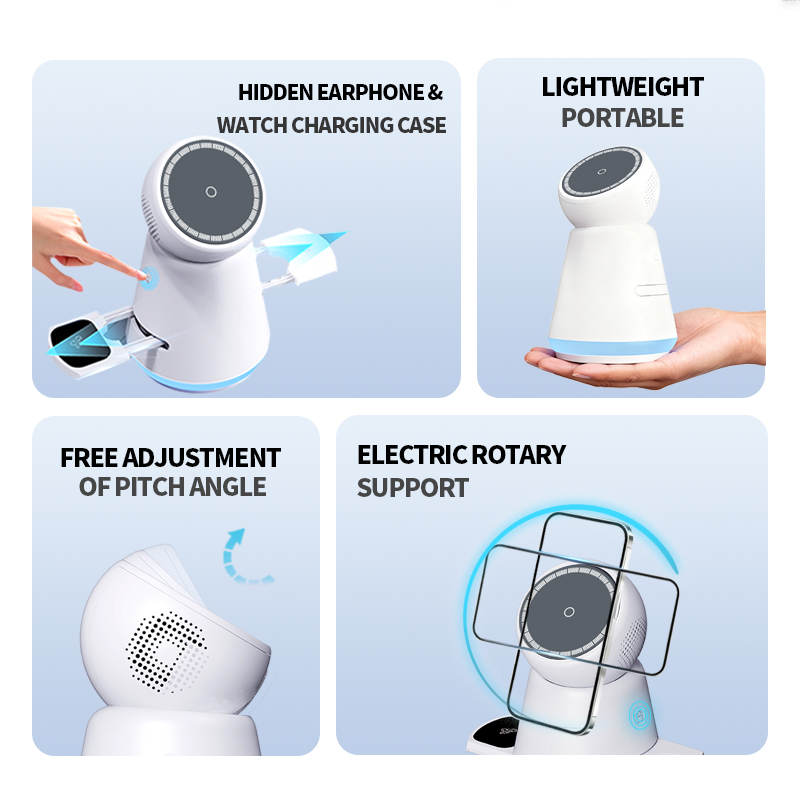
Three common forms appear in a wireless catalog: a foldable travel 3-in-1, a standing or rotary desk dock, and a flatter pad with two or three positions. Choose the form from the channel. Gift and desk use usually want a stand or rotary dock that holds a phone upright. Travel and retail “in a bag” use usually want a foldable. A pad is simpler and often cheaper, and it may be the honest SKU when the brand does not need a stand.
WECENT’s catalog includes a rotary 3-in-1 (the R9 3-in-1 rotary touch wireless charger), foldable gift-oriented models, and magnetic 3-in-1 stands. Use those pages as form examples after a live-page check. Do not assume a rotary dock and a foldable share a coil design, a Qi identity, or a watch-year list.
Production tests unique to a multi-coil dock: alignment, FOD, and simultaneous load
A multi-coil dock needs production tests that a single pad does not: alignment at each position, foreign-object detection at each coil (and with two or three positions occupied), and a simultaneous-load run with a documented thermal result. FOD method is covered in a companion article; here, the requirement is that FOD is not only run on the phone pad. A coin on the watch puck or in the earbud well is a different path.
If the dock rotates or folds, add a mechanical cycle and a repeat alignment check after cycling. A rotary SKU that charges on day one and misses after a month of turning is a hinge and cable-routing problem, which the 5-in-1 article discusses in more depth for clock-and-speaker housings.

Using live 3-in-1 catalog models only with verified claims from product pages
After a product-page check, R9 is catalogued as a 3-in-1 rotary touch wireless charger, and other live models describe foldable or magnetic 3-in-1 forms with published per-position wattages on their pages. Quote only what the current page and the report state. Do not extend a “supports Apple Watch” line into an undated universal claim, and do not copy a Qi2 logo onto a SKU whose page does not make that claim. A Qi or Qi2 identity, if used, should be evidenced against current Wireless Power Consortium documents, the Qi wireless charging standard, and, where Qi2 25W is claimed, the WPC’s 23 July 2025 Qi2 25W news release, with the product checked in the certified products database. The WPC knowledge base is a further official entry; this article will not invent logo or tolerance rules. This article does not assert USB-IF, WPC or safety certificates for any named model.
Corporate-gift MOQ and decoration — unverified figures, never invented
Minimum order quantities, decoration setup fees and gift-pack lead times are quotation items. This article will not invent an MOQ, a typical decoration price, or a standard lead time for a 3-in-1 gift SKU, even where a product page or a brand brief mentions a figure. Ask for a quotation against the artwork, the carton and the quantity you actually need, and treat any site figure as unverified until that quotation exists.
What can be specified now, before a price is discussed, is the decoration method (print, plate, in-mould), the logo position, and whether decoration sits on a cosmetic shell that can be swapped without touching the coil stack.
After-sales: which coil or magnet is a service part
The contract should say whether a failed phone coil, watch puck or magnet array is a service part, a module, or a full-unit swap. Gift-channel buyers often prefer a full-unit swap; retail may need a spare puck. Either way, the part has to be named, and a watch-puck replacement has to be the same model-year specification as the original. A mixed puck in a service stock is how a “compatible” claim breaks after the sale.
Firmware and coil-vendor changes that affect one position should reopen the relevant production tests, not only a cosmetic check of the replacement part.
A 3-in-1 OEM RFQ appendix a factory can quote
A factory can quote a 3-in-1 when the appendix includes: the form (fold, stand/rotary, pad); a coil-layout drawing; a power-budget table including simultaneous load; a watch model-year list and an earbud-case list; FOD and thermal tests at each position; packaging, logo and carton for the gift or retail channel; after-sales part policy; and the certification path (Qi or Qi2 identity, safety, EMC) with no certificates invented. MOQ and lead time wait for the quotation. That appendix is the difference between a gift headline and a SKU a factory can actually build.
Conclusion
A 3-in-1 wireless OEM program is a coil-layout, watch-year and simultaneous-load specification, with gift packaging written on top. Keep power budgets in a table, treat watch compatibility as dated, and do not invent an MOQ. Use catalog models only as published, and only after a live-page check.
If you are writing a 3-in-1 wireless charger RFQ for a gift or retail OEM program, you can send the intended form, watch-year list and packaging scope to WECENT through the wireless charger OEM page. This is a request for a sourcing discussion, a quotation or a sample plan, not an order.
FAQ
Can a 3-in-1 wireless charger be specified as compatible with every Apple Watch?
No. Watch charging is model-year dependent. Magnet geometry, puck height and the watch’s charging requirement change across years, and a catalog mention of Apple Watch support is not a universal claim. An OEM RFQ should name the watch models and years to be tested, and a new watch year should reopen that test. This article will not invent a list of supported years for any factory SKU. If a supplier cannot produce a dated test list, do not print “all Apple Watch models” on a gift carton.
Why is a single “25W” or “15W” headline not enough on a 3-in-1 RFQ?
Because a 3-in-1 has three positions that may not each receive the headline figure, and because the simultaneous total is a different number from the phone-pad maximum. The specification should state published wattage at the phone, watch and earbud positions and the budget when all three are occupied, taken from the live product page or a report for that SKU. Adding three published figures into a new marketing total, or assuming a family “25W” is available at every coil, is how a gift-channel sell-sheet parts company with the product.
What production tests are unique to a multi-coil 3-in-1 dock?
Alignment at each position, foreign-object detection at each coil and with more than one position occupied, and a simultaneous-load thermal run. If the unit folds or rotates, add a mechanical cycle and a repeat alignment check after cycling. A single-pad FOD check or a one-phone bench charge does not cover a 3-in-1. The FOD method itself should follow current WPC/Qi practice without unofficial thresholds; the requirement here is that the method is applied to every coil the user can occupy.
Should a corporate-gift 3-in-1 RFQ include a standard MOQ?
Not as a fact invented in the article or copied from an unverified product-page figure. MOQ, decoration setup and lead time are quotation items for the artwork, carton and quantity the buyer actually needs. The RFQ can and should specify decoration method, logo position, gift-box standard and whether a cosmetic shell is separable from the coil stack. Those items let a factory quote. A “typical MOQ” presented as a factory standard, without a quotation, is not a specification.
{
“@context”: “https://schema.org”,
“@type”: “FAQPage”,
“mainEntity”: [
{
“@type”: “Question”,
“name”: “Can a 3-in-1 wireless charger be specified as compatible with every Apple Watch?”,
“acceptedAnswer”: {
“@type”: “Answer”,
“text”: “No. Watch charging is model-year dependent. Magnet geometry, puck height and the watch’s charging requirement change across years, and a catalog mention of Apple Watch support is not a universal claim. An OEM RFQ should name the watch models and years to be tested, and a new watch year should reopen that test. This article will not invent a list of supported years for any factory SKU. If a supplier cannot produce a dated test list, do not print “all Apple Watch models” on a gift carton.”
}
},
{
“@type”: “Question”,
“name”: “Why is a single “25W” or “15W” headline not enough on a 3-in-1 RFQ?”,
“acceptedAnswer”: {
“@type”: “Answer”,
“text”: “Because a 3-in-1 has three positions that may not each receive the headline figure, and because the simultaneous total is a different number from the phone-pad maximum. The specification should state published wattage at the phone, watch and earbud positions and the budget when all three are occupied, taken from the live product page or a report for that SKU. Adding three published figures into a new marketing total, or assuming a family “25W” is available at every coil, is how a gift-channel sell-sheet parts company with the product.”
}
},
{
“@type”: “Question”,
“name”: “What production tests are unique to a multi-coil 3-in-1 dock?”,
“acceptedAnswer”: {
“@type”: “Answer”,
“text”: “Alignment at each position, foreign-object detection at each coil and with more than one position occupied, and a simultaneous-load thermal run. If the unit folds or rotates, add a mechanical cycle and a repeat alignment check after cycling. A single-pad FOD check or a one-phone bench charge does not cover a 3-in-1. The FOD method itself should follow current WPC/Qi practice without unofficial thresholds; the requirement here is that the method is applied to every coil the user can occupy.”
}
},
{
“@type”: “Question”,
“name”: “Should a corporate-gift 3-in-1 RFQ include a standard MOQ?”,
“acceptedAnswer”: {
“@type”: “Answer”,
“text”: “Not as a fact invented in the article or copied from an unverified product-page figure. MOQ, decoration setup and lead time are quotation items for the artwork, carton and quantity the buyer actually needs. The RFQ can and should specify decoration method, logo position, gift-box standard and whether a cosmetic shell is separable from the coil stack. Those items let a factory quote. A “typical MOQ” presented as a factory standard, without a quotation, is not a specification.”
}
}
]
}