
A retractable GaN charger is a mechanical product first. The reel, the conductor and the strain relief will decide after-sales cost long before a wattage headline does. A factory that quotes only “100 W, retractable cable” is quoting a slogan, not a serviceable design. This page is a process path for OEM buyers who want cycle-life, gauge and after-sales written as tests. It will not invent cycle-life numbers, and it will use a catalog model only as the live product page states.
Platform context is in GaN chargers, GaN charger manufacturing and sourcing, and the GaN charger category.
The retractable system as three parts: conductor, spring or motor, and strain relief
A retractable charger is three mechanical systems in one housing: the conductor, the spring or motor that retracts it, and the strain relief at the shell and the plug. A quotation that treats those three as one “reel” cannot be compared with a quotation that has tested them separately.
After-sales failures usually start at one of the three, not at all three at once. Ask for a diagram, a parts list, and a statement of which parts are serviceable. A spring-driven reel and a motor-driven reel are different products, with different noise, different wear and different repair paths. Strain relief at both ends is part of the electrical as well as the mechanical file.
Cycle-life and conductor gauge: how to specify them as tests, not slogans
Cycle-life and conductor gauge belong in the specification as tests: a number of extend-and-retract cycles at a stated load and a stated rate, a visual and electrical inspection after those cycles, and a gauge or cross-section that supports the current the port will advertise. This page does not invent a cycle count or a gauge, because those figures are not a fact until they are required and measured. “Durable reel” and “as per factory standard” are not tests. The factory proposes a method and a number; the buyer accepts them on samples and on an outgoing gate.
Wattage, e-marker and heat inside a retractable 100W design
A 100 W USB-C path and a retractable cable that is specified at a lower wattage are two different conductors, and they must be written that way. Heat inside a coiled cable is a design and a test issue, not a slogan. If a kit or an integrated cable must carry a high current, the pairing with an e-marker, where the program requires one, is discussed in the existing article on e-marker chips and 5 A cables. Do not assume a retractable lead can carry every watt the housing can advertise. Write the limit, and test it after a stated number of cycles, against the USB-IF documents the program follows. Protocol expectations for the USB-C path belong with USB-C PD and PPS as well as with the mechanical file.
After-sales: whether the reel is a service part or a full-unit swap
Decide, before tooling, whether a failed reel is a service part or a full-unit swap. That decision drives spare-parts planning, warranty handling and the housing design itself. A sealed unit that cannot be opened without destroying a safety seal is a swap product; say so. A modular reel that can be replaced in a service centre is a different cost model. The RFQ should ask for the intended after-sales path, a recommended spare, and a method for disposing of a unit whose cable is damaged. This page does not publish a warranty period.
Safety: pinch, child-access and broken-conductor failure modes
Write pinch, child-access and broken-conductor failures as explicit cases. A retracting cable can pinch skin or a thin object; a broken conductor inside a worn jacket can be a safety finding, not only a function finding. Ask how the product behaves if a conductor opens or shorts, and how the housing prevents a child from pulling a loop into a pinch point. Those questions sit in the safety file with the rest of the CB and national evaluation, not in a brochure. A Union SKU may also have to sit against instruments such as Directive (EU) 2022/2380 for the connector side of the program.

Production tests that belong on the outgoing gate for a retractable SKU
Outgoing tests for a retractable SKU should include a cycle or a shortened cycle sample, a pull test at the strain relief, an electrical test at the advertised cable wattage, and a visual check for jacket damage and uneven retraction. The gate should record the firmware and hardware revision if the product also has a display. A power-only outgoing test that never moves the reel is an incomplete gate for this form. Energy filings, where they apply, still follow the relevant external power supply rule.
Using the WEX100S product page as a catalog example — claims only as published
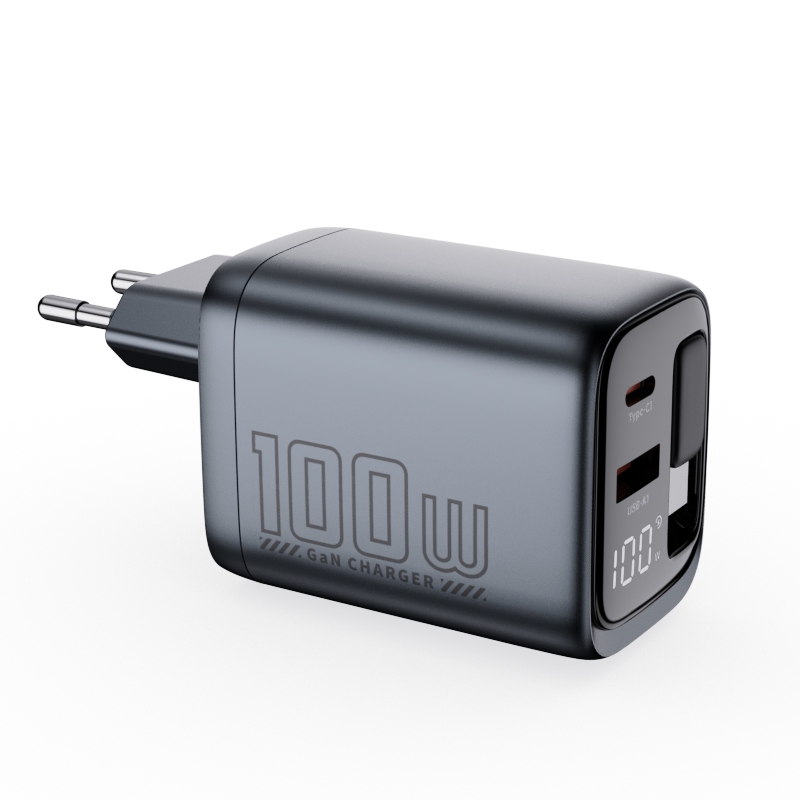
The live WEX100S product page, as opened for this article, states a 100 W maximum, a retractable cable, a real-time power display, input 220 VAC, 50/60 Hz, 1.5 A max, a USB-C output of 5 V/9 V/15 V/20 V up to 5 A (100 W max), an integrated-cable output up to 65 W, a USB-A output up to 36 W, combined USB-C + USB-A of 65 W + 30 W, and a retractable-cable combination of 65 W + 35 W, in a 61 × 48 × 31 mm metallic-gray housing. Those are catalog statements. The input line as published is 220 VAC; a multi-market buyer should confirm the input range on the current page and on the rating label. The page does not, in the text that was opened, publish a cycle-life figure, and this article will not invent one.
Packaging and travel-use wear that a wall-charger RFQ usually forgets
A retractable charger is carried, dropped, and packed against keys and coins. The RFQ should specify packaging that protects the reel and the plug, a travel-use abrasion case if the brand wants one, and a test that includes dust or pocket debris if the product will be marketed for travel. A wall-charger RFQ written for a rigid brick usually forgets those items. Include them, or accept that after-sales will discover them.
When a retractable platform is the wrong choice versus a detachable cable kit
A retractable platform is the wrong choice when the program needs a replaceable cable as the primary service part, when the advertised wattage on the housing is higher than a reliable retractable lead can carry, or when the brand is not prepared to handle reel failures as a distinct after-sales class. A detachable cable kit, specified with the right gauge and, where required, an e-marker, is then the cleaner design. The choice is a service and a safety choice, not a catalogue preference. Protocol expectations still follow the USB-IF Compliance Program the SKU will claim.
Specification clauses a buyer should refuse to leave “as per factory standard”
Refuse to leave cycle-life, conductor gauge, strain-relief pull, after-sales path, pinch and broken-conductor behaviour, and outgoing reel tests as “as per factory standard.” Those clauses are the product. A factory standard that cannot be written down cannot be compared, and cannot be tested on a sample. Ask for methods, numbers and fail paths, then accept them in writing.
Conclusion
Specify a retractable GaN charger as a mechanical and electrical product: conductor, spring or motor, and strain relief, with cycle-life and gauge written as tests, and with an after-sales path decided before tooling. Use catalog figures only as a live page states them. Do not leave reel life “as per factory standard,” and do not invent a cycle count that has not been required and measured.
If your team is specifying a retractable GaN charger and wants to discuss reel-life and service items for a SKU, you can send that scope through the GaN charger manufacturing and sourcing page. This is a request for a project discussion.
FAQ
How should cycle-life be specified for a retractable GaN charger?
Specify cycle-life as a test: a number of extend-and-retract cycles at a stated load and a stated rate, then a visual and electrical inspection. Specify conductor gauge or cross-section against the current the cable will advertise. This answer will not invent a cycle count, because that figure is not a fact until it is required and measured. “Durable reel” and “as per factory standard” are not tests. The factory proposes a method and a number; the buyer accepts them on samples and on an outgoing gate that actually moves the reel.
Should a retractable cable be assumed to carry the housing’s full wattage?
No. A 100 W path on a USB-C port and a retractable cable specified at a lower wattage are two different conductors and should be written that way. Heat inside a coiled cable is a design and a test issue. The live WEX100S page, as opened for this article, states an integrated-cable output up to 65 W against a 100 W maximum on USB-C; those are catalog statements to be confirmed on a sample. Pair any high-current kit cable with the e-marker requirements the program actually has, and test after a stated number of cycles.
When is a retractable platform the wrong OEM choice?
A retractable platform is the wrong choice when the program needs a replaceable cable as the primary service part, when the advertised wattage on the housing is higher than a reliable retractable lead can carry, or when the brand is not prepared to handle reel failures as a distinct after-sales class. A detachable cable kit is then the cleaner design. The choice is a service and a safety choice, not a catalogue preference, and it should be made before tooling, with the after-sales path written down.
What outgoing tests belong on a retractable charger gate?
Outgoing tests should include a cycle or a shortened cycle sample, a pull test at the strain relief, an electrical test at the advertised cable wattage, and a visual check for jacket damage and uneven retraction. A power-only outgoing test that never moves the reel is incomplete for this form. Record firmware and hardware revision if the product also has a display. Pinch, child-access and broken-conductor behaviour belong in the safety file as well, and should not be left “as per factory standard.”
{
“@context”: “https://schema.org”,
“@type”: “FAQPage”,
“mainEntity”: [
{
“@type”: “Question”,
“name”: “How should cycle-life be specified for a retractable GaN charger?”,
“acceptedAnswer”: {
“@type”: “Answer”,
“text”: “Specify cycle-life as a test: a number of extend-and-retract cycles at a stated load and a stated rate, then a visual and electrical inspection. Specify conductor gauge or cross-section against the current the cable will advertise. This answer will not invent a cycle count, because that figure is not a fact until it is required and measured. “Durable reel” and “as per factory standard” are not tests. The factory proposes a method and a number; the buyer accepts them on samples and on an outgoing gate that actually moves the reel.”
}
},
{
“@type”: “Question”,
“name”: “Should a retractable cable be assumed to carry the housing’s full wattage?”,
“acceptedAnswer”: {
“@type”: “Answer”,
“text”: “No. A 100 W path on a USB-C port and a retractable cable specified at a lower wattage are two different conductors and should be written that way. Heat inside a coiled cable is a design and a test issue. The live WEX100S page, as opened for this article, states an integrated-cable output up to 65 W against a 100 W maximum on USB-C; those are catalog statements to be confirmed on a sample. Pair any high-current kit cable with the e-marker requirements the program actually has, and test after a stated number of cycles.”
}
},
{
“@type”: “Question”,
“name”: “When is a retractable platform the wrong OEM choice?”,
“acceptedAnswer”: {
“@type”: “Answer”,
“text”: “A retractable platform is the wrong choice when the program needs a replaceable cable as the primary service part, when the advertised wattage on the housing is higher than a reliable retractable lead can carry, or when the brand is not prepared to handle reel failures as a distinct after-sales class. A detachable cable kit is then the cleaner design. The choice is a service and a safety choice, not a catalogue preference, and it should be made before tooling, with the after-sales path written down.”
}
},
{
“@type”: “Question”,
“name”: “What outgoing tests belong on a retractable charger gate?”,
“acceptedAnswer”: {
“@type”: “Answer”,
“text”: “Outgoing tests should include a cycle or a shortened cycle sample, a pull test at the strain relief, an electrical test at the advertised cable wattage, and a visual check for jacket damage and uneven retraction. A power-only outgoing test that never moves the reel is incomplete for this form. Record firmware and hardware revision if the product also has a display. Pinch, child-access and broken-conductor behaviour belong in the safety file as well, and should not be left “as per factory standard.””
}
}
]
}