
A foldable-plug GaN charger looks like a small travel brick. It is also a hinge, a pin, and a pair of safety evaluations: one with the plug folded, and one with the plug open. This page is a process path for OEM buyers who want those checks written before a tool-go on an ice-cube platform. It will not invent hinge-cycle, IP or mechanical ratings, and it will use the Ice Cube catalog family only as the live product page states.
Platform context is in GaN chargers, GaN charger manufacturing and sourcing, and the GaN charger category.
The ice-cube / foldable-plug form: what moves, and what must stay rigid
On a foldable-plug ice-cube charger, the plug pins and the hinge are the parts that move. The insulation barriers, the pin-retention structure and the connector face must stay rigid. A specification that treats the whole housing as one moving part will miss the creepage and pin-alignment failures seen in the field.
Ask for a diagram that names the hinge axis, the pin inserts, and the surfaces that must not flex. A folding US or EU plug is a different mechanism from a detachable plug slice, and the two should not share a silent assumption about tooling or about the safety file.
Hinge and pin life: writing a cycle and torque test into the OEM spec
Hinge and pin life belong in the specification as tests: a number of fold-and-unfold cycles, a torque or a force at stated angles, and a visual and electrical inspection afterwards for cracks, looseness and pin misalignment. This page does not invent a cycle count or a torque figure, because those ratings were not verified as published facts for a catalog model. The factory proposes a method and a number; the buyer accepts them on samples and on an outgoing sample gate. “Feels solid” is not a test.
Creepage, clearance and folded-versus-open safety evaluations
Folded and open are two mechanical states, and they can be two different creepage and clearance geometries. The safety evaluation should consider both, including any position in between if a pin can stop short of full travel. A report that only photographed the product open may not have seen the folded case. Ask the factory and the laboratory which states were evaluated, and keep that statement with the CB or national file. Do not assume a display-less or a rigid-plug report covers a folding SKU.
Multi-market plugs on a foldable housing: when a new report is required
A new pin standard, a new hinge geometry or a new folding path is a reason to ask whether a new safety report is required, not a reason to assume the existing one extends. US and EU foldable plugs are different pin systems; a UK pin, if offered, is another. Ask which variants share a report and which need a new evaluation, including EMC and any external power supply filing. A Union SKU may also need to be named against instruments such as Directive (EU) 2022/2380 on the connector side. Protocol work, if claimed, still follows the USB-IF Compliance Program.
Travel wear: pocket debris, lint and mechanical shock
Ice-cube chargers are carried in pockets and bags. The RFQ should include debris and lint at the hinge, a drop or shock case, and a check that pins still align after that wear. A hinge that loosens will change both the feel and the safety geometry. Packaging should protect the folded pins in transit. These items are easy to omit from a wall-charger RFQ and expensive to discover in returns.
Production checks for pin alignment and housing cracks
On the line, check pin alignment, pin length, hinge play, and cracks at the hinge bosses and at the plug shoulder. First-piece confirmation should include a fold cycle, not only a power-up. A cracked boss that still holds for a short outgoing test can fail in a bag a week later. Record the cavity number if more than one tool is in use, so a crack can be traced.
Using the Ice Cube catalog family as a form-factor example, verified on the product page
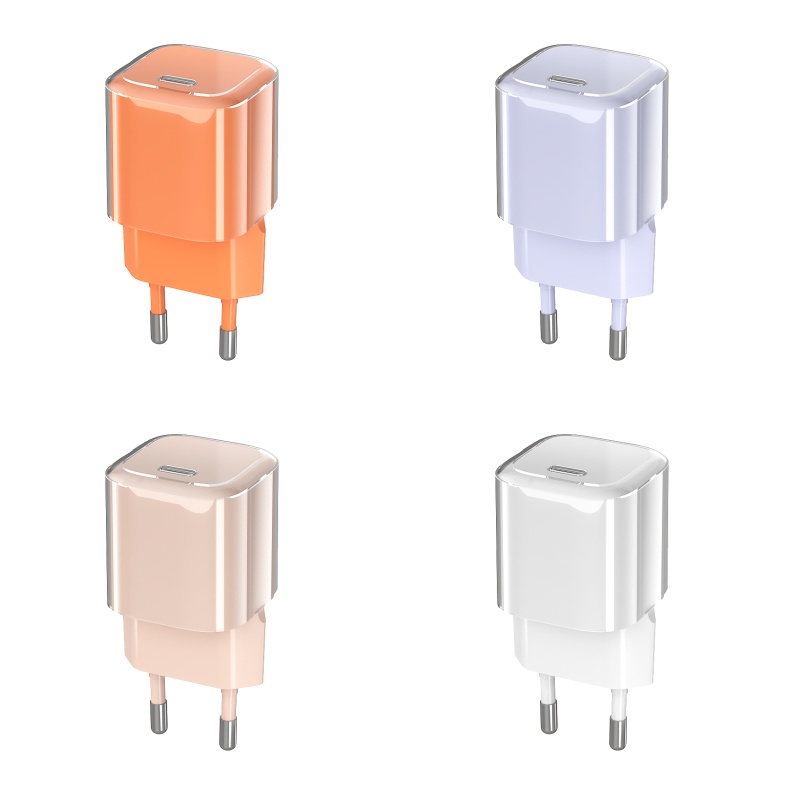
The live Ice Cube foldable-plug GaN charger page, as opened for this article, presents a compact cube with foldable US and EU plugs, in 20 W, 35 W, 45 W and 65 W versions, with colour options including orange, white, blue, pink and purple, and with OEM or ODM customization of logo, colour, packaging and private label. Those are catalog statements about form, wattage steps and customization. The page does not, in the text that was opened, publish a hinge-cycle rating or an IP rating, and this article will not invent either. A buyer should re-read the current page and confirm wattage and plug options on a sample of the intended SKU.
When a foldable plug is a poor fit for a high-wattage or grounded design
A foldable plug is a poor fit when the current and the thermal load ask more of a small hinge than the mechanism can honestly give, or when the market requires a grounded pin system that the ice-cube form has not been evaluated to carry. In those cases a rigid plug, a detachable slice, or a larger housing is the cleaner design. The decision is a safety and a mechanical decision, not a preference for how the product looks in a travel photograph. USB-C PD and PPS expectations still have to be written for the wattage that remains.

Labeling and instruction issues unique to a folding plug
Instructions should show the open and folded states, warn against forcing a half-open hinge, and say how to clear debris. Rating labels must remain readable in the state the product is stored and in the state it is used. A label that is only visible when the plug is open will be missed in a folded pack. If a market requires a particular warning, put it on the artwork list before tooling, not after the first shipment.
A sample-evaluation protocol a buyer can run before tooling approval
Before a tool-go, run a short protocol on samples: fold-and-unfold cycles at the proposed number, a torque or force check, a visual inspection for cracks, a pin-alignment measurement, a safety-relevant dimensional check in both folded and open states, a travel-wear or drop case if that is in the specification, and a full electrical test at the advertised wattage. Record the sample revision. Accept the tool-go only against that record, not against a first impression of a tidy cube. Published USB-IF documents still govern protocol claims on the USB-C face.
Conclusion
Specify a foldable-plug GaN charger as a hinge and pin product with tests for cycle, torque, alignment and both folded and open safety states. Use the Ice Cube catalog family only as the live page states, and do not invent hinge-cycle or IP ratings. Approve tooling after a sample protocol, not after a photograph.
If your team is specifying a foldable-plug GaN charger and wants to discuss hinge, pin and certification checks for a SKU, you can send that scope through the GaN charger manufacturing and sourcing page. This is a request for a project discussion.
FAQ
Why must a foldable-plug charger be evaluated in both folded and open states?
Folded and open are two mechanical states, and they can be two different creepage and clearance geometries. A pin can also stop short of full travel. A report that only photographed the product open may not have seen the folded case. Ask the laboratory which states were evaluated, and keep that statement with the safety file. The insulation barriers and the pin-retention structure must stay rigid in both states; only the intended hinge and pins should move. A rigid-plug report should not be assumed to cover a folding SKU.
Can a buyer rely on a published hinge-cycle rating for an ice-cube SKU?
Only if the live product page, or a test report the buyer has actually seen, states that rating. The Ice Cube page opened for this article presents 20 W, 35 W, 45 W and 65 W versions, foldable US and EU plugs, colour options and OEM customization; it does not, in the text that was opened, publish a hinge-cycle or IP rating. This answer will not invent one. Write a cycle and torque test into the OEM specification, accept it on samples, and run a production check for pin alignment and cracks at the hinge bosses.
When is a foldable plug a poor fit for a GaN charger program?
A foldable plug is a poor fit when the current and the thermal load ask more of a small hinge than the mechanism can honestly give, or when the market requires a grounded pin system that the ice-cube form has not been evaluated to carry. In those cases a rigid plug, a detachable slice, or a larger housing is the cleaner design. The decision is a safety and a mechanical decision, not a preference for how the product looks in a travel photograph.
What should a sample protocol include before a foldable-plug tool-go?
Run fold-and-unfold cycles at the proposed number, a torque or force check, a visual inspection for cracks, a pin-alignment measurement, a safety-relevant dimensional check in both folded and open states, a travel-wear or drop case if that is in the specification, and a full electrical test at the advertised wattage. Record the sample revision. Accept the tool-go only against that record, not against a first impression of a tidy cube. Instructions and labels for both states should already be on the artwork list.
{
“@context”: “https://schema.org”,
“@type”: “FAQPage”,
“mainEntity”: [
{
“@type”: “Question”,
“name”: “Why must a foldable-plug charger be evaluated in both folded and open states?”,
“acceptedAnswer”: {
“@type”: “Answer”,
“text”: “Folded and open are two mechanical states, and they can be two different creepage and clearance geometries. A pin can also stop short of full travel. A report that only photographed the product open may not have seen the folded case. Ask the laboratory which states were evaluated, and keep that statement with the safety file. The insulation barriers and the pin-retention structure must stay rigid in both states; only the intended hinge and pins should move. A rigid-plug report should not be assumed to cover a folding SKU.”
}
},
{
“@type”: “Question”,
“name”: “Can a buyer rely on a published hinge-cycle rating for an ice-cube SKU?”,
“acceptedAnswer”: {
“@type”: “Answer”,
“text”: “Only if the live product page, or a test report the buyer has actually seen, states that rating. The Ice Cube page opened for this article presents 20 W, 35 W, 45 W and 65 W versions, foldable US and EU plugs, colour options and OEM customization; it does not, in the text that was opened, publish a hinge-cycle or IP rating. This answer will not invent one. Write a cycle and torque test into the OEM specification, accept it on samples, and run a production check for pin alignment and cracks at the hinge bosses.”
}
},
{
“@type”: “Question”,
“name”: “When is a foldable plug a poor fit for a GaN charger program?”,
“acceptedAnswer”: {
“@type”: “Answer”,
“text”: “A foldable plug is a poor fit when the current and the thermal load ask more of a small hinge than the mechanism can honestly give, or when the market requires a grounded pin system that the ice-cube form has not been evaluated to carry. In those cases a rigid plug, a detachable slice, or a larger housing is the cleaner design. The decision is a safety and a mechanical decision, not a preference for how the product looks in a travel photograph.”
}
},
{
“@type”: “Question”,
“name”: “What should a sample protocol include before a foldable-plug tool-go?”,
“acceptedAnswer”: {
“@type”: “Answer”,
“text”: “Run fold-and-unfold cycles at the proposed number, a torque or force check, a visual inspection for cracks, a pin-alignment measurement, a safety-relevant dimensional check in both folded and open states, a travel-wear or drop case if that is in the specification, and a full electrical test at the advertised wattage. Record the sample revision. Accept the tool-go only against that record, not against a first impression of a tidy cube. Instructions and labels for both states should already be on the artwork list.”
}
}
]
}
