
A 65 W 2C1A charger is not an exciting headline, which is why it remains a workhorse OEM SKU. The work is in the port-sharing map and in the regional plug family, not in a “best 65 W” slogan. Two factories will quote two different products if those maps are left unwritten. This page is a process path for catalog and program managers. Exact allocation figures are model-dependent and are used only as a live product page states them.
Platform context is in GaN chargers, GaN charger manufacturing and sourcing, and the GaN charger category.
Why 65W 2C1A remains a workhorse SKU for OEM catalogs
A 65 W 2C1A remains a workhorse because it covers a primary USB-C laptop path and a second USB-C or USB-A phone path in a housing that can still travel. That role holds only when the specification states how 65 W is shared, and which plug variants the family will carry.
A 2C1A layout is a different BOM and a different allocation problem from a single-port 65 W brick. Treating them as one SKU with two silkscreens is how a workhorse becomes a returns item.
Port-sharing rules a specification must state in watts, not in adjectives
Port sharing must be written in watts, and in PDOs, for each single-port and each combined condition the product will claim. “Smart allocation” and “up to 65 W” are not rules. The specification should state what the primary USB-C advertises alone, what the second USB-C and the USB-A advertise alone, and what each port delivers when two or three ports are loaded. Protocol language sits with USB-IF Compliance and with USB-C PD and PPS. A factory that cannot fill the table cannot quote the product.
Laptop-plus-phone versus two-phone loads: two different allocation maps
A laptop-plus-phone load and a two-phone load are two different maps. The first usually asks the primary USB-C to hold enough power for a notebook to stay at charge, while the second USB-C or USB-A feeds a phone. The second asks two mid-power ports to stay useful at once. A map that collapses the primary port too far under a second load will drop a notebook into a slow-charge state. Write both maps, and test both. Do not invent a device’s peak demand; write the charger’s advertised split and let the device take what it negotiates.
Regional plug strategy: one housing, EU/UK/US/AUS slices, certification consequences
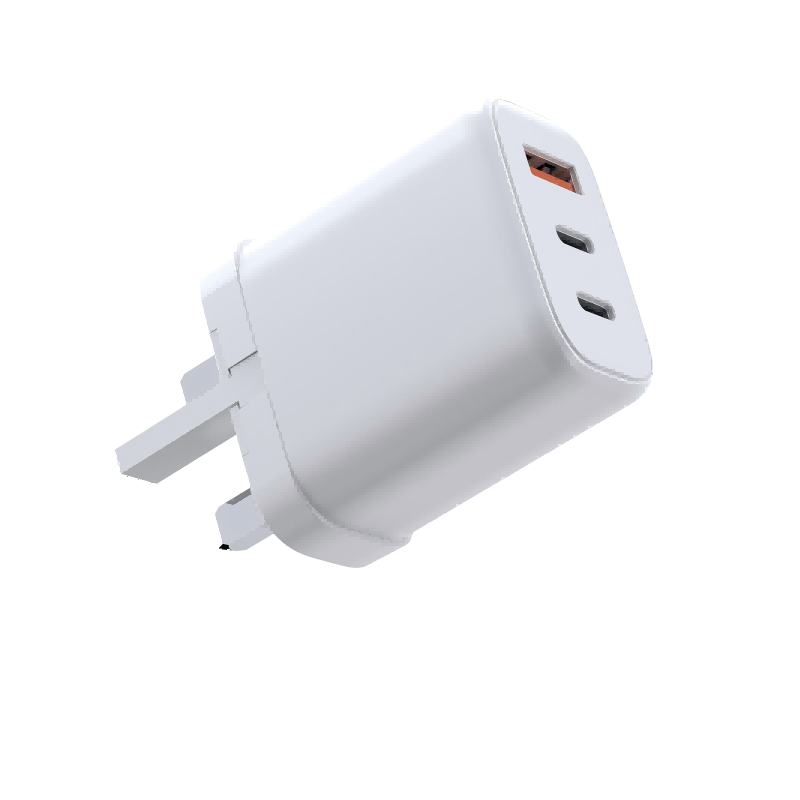
A regional plug strategy is one housing with EU, UK, US and AUS slices, or a foldable pin on a subset of those markets, each with a certification consequence. A new pin standard is a reason to ask whether a new CB or national file is required. A Union variant may need to be named against Directive (EU) 2022/2380, and energy filings against the relevant external power supply rule. Shared steel is a saving only when the shared and unique tools, and the shared and unique reports, are written down.
PPS and PD 3.0/3.1 expectations at 65W for Android and laptop accessories
If the program needs Programmable Power Supply, write the voltage range and the current, and say whether it is required on the primary USB-C, on both USB-C ports, or not on USB-A. PD 3.0 or 3.1 expectations should be written against the USB-IF documents the SKU will follow, not against a device-brand slogan. This page does not invent a phone or a laptop peak, and it does not treat a protocol name as a substitute for a PDO table.
Thermal and case-temperature acceptance at 65W continuous
Write a thermal acceptance: a continuous 65 W load, or the published split under two loads, at a stated ambient, with a case-temperature and a derating rule the buyer can measure. This page does not invent a temperature limit. The factory proposes a method and a limit; the buyer accepts them on a sample in a repeatable setup. A travel housing that is comfortable in a five-minute demonstration and too hot at forty minutes is a specification miss, not a user miss.
How to use WET and WEP 65W catalog models as examples after checking live specs
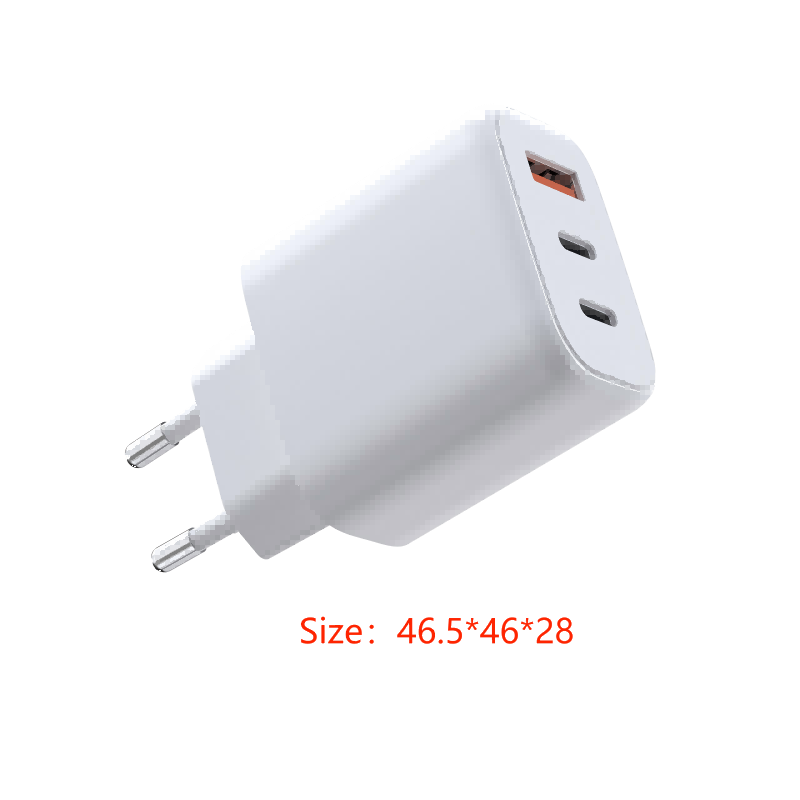
Use a catalog model only after reading the live product page. The WET-67-ACC page, as opened for this article, states a 65 W 2C1A charger with interchangeable EU, UK, US and AUS plugs, input AC 100–240 V, 50/60 Hz, 1.5 A, USB-C1 at 5 V/3 A, 9 V/3 A, 12 V/3 A, 15 V/3 A and 20 V/3.25 A (max 65 W), USB-C2 at 5 V/2.4 A, 9 V/2.22 A and 12 V/1.67 A, USB-A at 5 V/2.4 A, 9 V/2 A and 12 V/1.5 A, and, when USB-C1 and USB-C2 are used together, USB-C1 PDOs including 20 V/2.25 A. The combined row as published does not, in the table that was opened, state USB-C2’s simultaneous share; a buyer should require that complete map and confirm it on a sample. The WEP-65-C page is a second catalog entry a buyer should likewise re-read; this article does not invent a port map for it. Page-listed certificates are claims to be evidenced by reports, not facts asserted here. Dimensions of 46.5 × 46 × 28 mm and a weight of about 92 g are as published for WET-67-ACC.
Kit contents: cable gauge and e-marker that must match the 65W claim
If a cable is in the kit, its gauge and, where the program requires one, its e-marker must match the 65 W claim the carton will carry. A 65 W PDO on the charger and a cable that cannot carry the current is a kit failure. The pairing with an e-marker, where the program requires one, should be written as a kit line, not as an accessory to be decided after the unit price.
A comparison sheet for two 65W OEM quotes that looks past unit price
Compare two 65 W quotes on the same allocation table, the same plug-variant list, the same certification list, the same kit cable, and the same thermal acceptance. A lower unit price that omits a combined-port map, a UK report or a kit cable is not a lower program cost until those lines are added. The sheet should also carry firmware and hardware revision of the samples.
When a catalog should step up to 100W instead of stretching 65W
Step up to 100 W when the primary-port remainder under a second load can no longer keep the intended notebook at charge, when two mid-power devices plus a notebook are the real use case, or when the thermal acceptance at 65 W continuous is already at the limit of the housing. Stretching a 65 W map with adjectives will not create those watts. The step-up is a portfolio decision, and it should be made on a written map, not on a headline.
Conclusion
Treat 65 W 2C1A as a workhorse whose specification is a port-sharing table and a regional plug family, with certification consequences for each slice. Use WET and WEP catalog models only as live pages state, complete any missing combined-port figures on a sample, and step up to 100 W when the written map no longer holds the intended load.
If your team is specifying a 65 W 2C1A OEM SKU and wants to discuss port maps and plug variants, you can send that scope through the GaN charger manufacturing and sourcing page. This is a request for a project discussion.
FAQ
Why must a 65W 2C1A specification state port sharing in watts?
“Smart allocation” and “up to 65 W” do not say what the primary USB-C delivers alone, or what remains when a second USB-C or a USB-A is loaded. A laptop-plus-phone load and a two-phone load are two different maps, and a collapse on the primary port will drop a notebook into a slow-charge state. The specification should state every claimed combination in watts and in PDOs. A factory that cannot fill that table cannot quote the product, and two quotes cannot be compared without it.
How should EU, UK, US and AUS plugs be planned on a 65W family?
Plan them as a regional plug family: one housing with slices, or a foldable pin on a subset of markets, each with a certification consequence. A new pin standard is a reason to ask whether a new safety or national file is required, not a reason to assume the existing one extends. Shared steel is a saving only when the shared and unique tools, and the shared and unique reports, are written down. The comparison sheet for two OEM quotes should include the plug-variant list, not only the unit price.
What does the WET-67-ACC page publish, and what should a buyer still require?
As opened for this article, the page states a 65 W 2C1A with EU, UK, US and AUS plugs, input 100–240 V, USB-C1 up to 20 V/3.25 A (max 65 W), published USB-C2 and USB-A single-port figures, and, when USB-C1 and USB-C2 are used together, USB-C1 PDOs including 20 V/2.25 A. The combined row as published does not state USB-C2’s simultaneous share. A buyer should require that complete map, confirm it on a sample, and treat page-listed certificates as claims to be evidenced by reports.
When should a catalog step up from 65W to 100W?
Step up when the primary-port remainder under a second load can no longer keep the intended notebook at charge, when two mid-power devices plus a notebook are the real use case, or when thermal acceptance at 65 W continuous is already at the limit of the housing. Stretching a 65 W map with adjectives will not create those watts. The step-up is a portfolio decision, and it should be made on a written allocation table, not on a headline. Kit cables must still match the wattage the carton will claim.
{
“@context”: “https://schema.org”,
“@type”: “FAQPage”,
“mainEntity”: [
{
“@type”: “Question”,
“name”: “Why must a 65W 2C1A specification state port sharing in watts?”,
“acceptedAnswer”: {
“@type”: “Answer”,
“text”: ““Smart allocation” and “up to 65 W” do not say what the primary USB-C delivers alone, or what remains when a second USB-C or a USB-A is loaded. A laptop-plus-phone load and a two-phone load are two different maps, and a collapse on the primary port will drop a notebook into a slow-charge state. The specification should state every claimed combination in watts and in PDOs. A factory that cannot fill that table cannot quote the product, and two quotes cannot be compared without it.”
}
},
{
“@type”: “Question”,
“name”: “How should EU, UK, US and AUS plugs be planned on a 65W family?”,
“acceptedAnswer”: {
“@type”: “Answer”,
“text”: “Plan them as a regional plug family: one housing with slices, or a foldable pin on a subset of markets, each with a certification consequence. A new pin standard is a reason to ask whether a new safety or national file is required, not a reason to assume the existing one extends. Shared steel is a saving only when the shared and unique tools, and the shared and unique reports, are written down. The comparison sheet for two OEM quotes should include the plug-variant list, not only the unit price.”
}
},
{
“@type”: “Question”,
“name”: “What does the WET-67-ACC page publish, and what should a buyer still require?”,
“acceptedAnswer”: {
“@type”: “Answer”,
“text”: “As opened for this article, the page states a 65 W 2C1A with EU, UK, US and AUS plugs, input 100–240 V, USB-C1 up to 20 V/3.25 A (max 65 W), published USB-C2 and USB-A single-port figures, and, when USB-C1 and USB-C2 are used together, USB-C1 PDOs including 20 V/2.25 A. The combined row as published does not state USB-C2’s simultaneous share. A buyer should require that complete map, confirm it on a sample, and treat page-listed certificates as claims to be evidenced by reports.”
}
},
{
“@type”: “Question”,
“name”: “When should a catalog step up from 65W to 100W?”,
“acceptedAnswer”: {
“@type”: “Answer”,
“text”: “Step up when the primary-port remainder under a second load can no longer keep the intended notebook at charge, when two mid-power devices plus a notebook are the real use case, or when thermal acceptance at 65 W continuous is already at the limit of the housing. Stretching a 65 W map with adjectives will not create those watts. The step-up is a portfolio decision, and it should be made on a written allocation table, not on a headline. Kit cables must still match the wattage the carton will claim.”
}
}
]
}