
A smart-screen GaN charger is an OEM measurement problem before it is a retail feature. The display has to measure something, under stated conditions, and the number it shows can become a marketing claim that needs evidence. This page is a process path for specifying, accepting and RFQ-ing that display. It is not a product review. Catalog figures are used only as they appear on a live product page, and any accuracy or “AI” function that is not specified there is left for the buyer to require and test.
Platform context is in GaN chargers, GaN charger manufacturing and sourcing, and the GaN charger category.
What a smart-screen charger is actually measuring — current, voltage, or a rounded estimate
A smart-screen charger is only as useful as what it measures. The specification should say whether the display reports measured voltage and current, a calculated wattage, or a rounded estimate, and under which load that number is taken. A pretty number without that statement is a marketing claim, not a measurement.
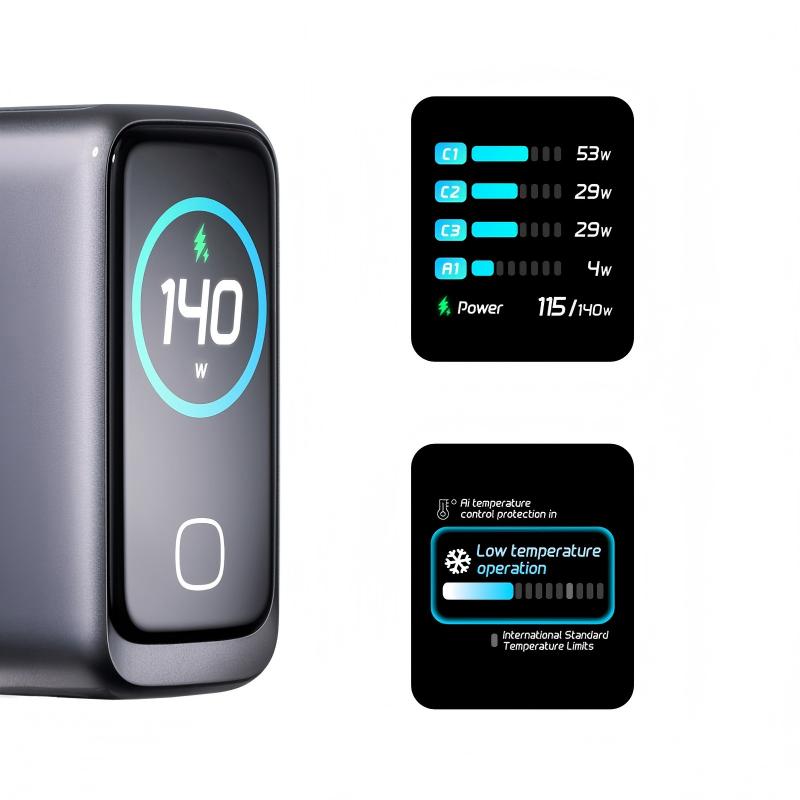
Ask whether each port is shown separately, whether the total is a sum of port readings, and whether the figure is averaged, peak, or instantaneous. Ask what the screen shows when a port is idle, and what it shows when negotiation is still in progress. Protocol language belongs with USB-C PD and PPS; the display specification still has to say how those negotiations appear as numbers.
Accuracy, refresh and load conditions a buyer should write into the specification
Write accuracy, refresh interval and load conditions as testable lines. An accuracy statement needs a tolerance, a range, and a method: for example, comparison against a calibrated meter at stated voltage and current points. A refresh rate needs a number, not the word “real-time.” This page does not invent those figures for any catalog model, because a live product page that does not publish them cannot be a source for them. The factory fills the lines; the sample is then measured against them.
Claims risk: when a display number becomes a marketing statement that needs evidence
Once a wattage appears on a screen, on a carton or in a listing, it is a claim. If the number is higher than the port is actually delivering, or is rounded in the buyer’s favour, it is a claims-risk item for the brand, not only a firmware issue. Align the display with the PDO table and with any USB-IF Compliance Program work the SKU will carry, and with the safety file. A marketing screenshot is not evidence. A measurement against a stated tolerance is.
Firmware, logging and privacy: what an OEM display should and should not store
Decide whether the product only displays, or also logs. If it logs, the specification should say what is stored, for how long, whether any identifier leaves the device, and how a user or a service centre clears it. A wall charger that stores nothing is a simpler privacy file. A charger that stores session history is a different product and should be described as such. Firmware revision of the display and of the power stage should be frozen for quotation samples, and recorded on the outgoing test.
UI languages, brightness and failure modes if the screen itself fails
Specify UI languages, brightness, and what happens if the screen fails: the charger should still negotiate and protect, and the failure should be obvious rather than silent. A black screen must not be the only way a user learns that a port is at full load. Ask for a stated behaviour at high ambient temperature, and for a stated behaviour when the product first plugs in. Artwork and language packs are packaging items as well as firmware items; they belong in the RFQ attachments.
EMC and safety: extra circuitry a display adds to a GaN brick
A display, a backlight and a small microcontroller are extra circuitry. They add emissions, immunity and isolation questions to the safety and EMC file, and they may change a CB evaluation when they are introduced into a previously approved housing. Do not assume a display-less report covers a screened SKU. Ask whether the display supply is isolated as required, and whether a failed backlight or a cracked cover creates an accessible live part. Energy filings, where they apply, follow the relevant external power supply rule and are not replaced by a wattage shown on a screen. A Union SKU may also have to be named against instruments such as Directive (EU) 2022/2380 on the connector side of the program.
Production calibration: how a line proves the screen matches the output
On the line, the screen has to be shown to match a measured output, at least at agreed points, and that check has to be recorded against the lot. A visual inspection that the screen lights up is not a calibration. Ask for the calibration method, the reference meter, the points, the tolerance, and the fail path. Ask how a unit that was reworked is re-checked. This is an outgoing gate, not a design-lab courtesy.
Using the WEX catalog family as a specification example, checked against live product pages
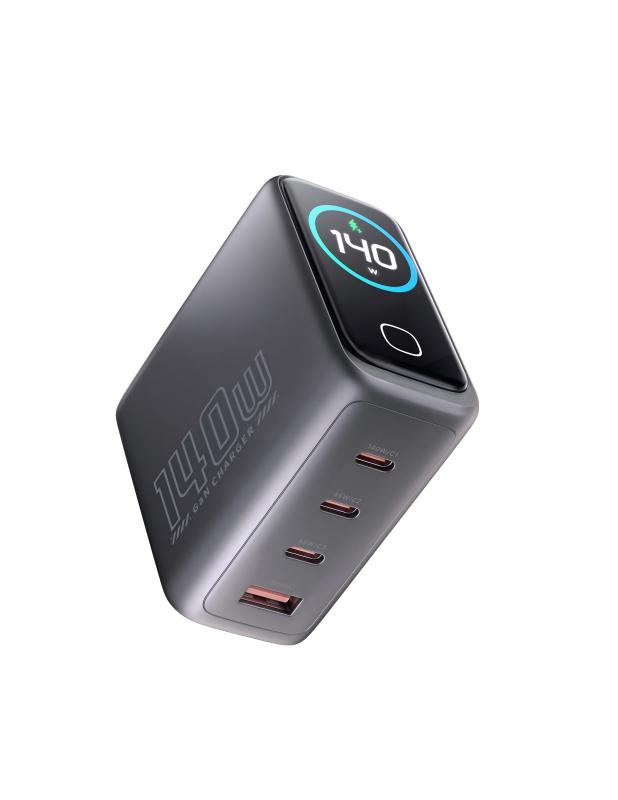
The live WEX140S product page, as opened for this article, states a 140 W maximum, a 3C+1A layout, input 110–240 V AC, 50/60 Hz, 2.6 A max, and port maxima of 140 W on USB-C1 (including a 28 V/5 A figure), 65 W on USB-C2, 65 W on USB-C3 and 30 W on USB-A1, with example splits such as C1+C2 at 100 W+35 W and C1+C2+C3 at 65 W+45 W+30 W, in a 69 × 69 × 36 mm US-standard housing, metallic gray, with real-time power visibility. Those figures are catalog statements. They are not, on the page that was opened, accompanied by a published display accuracy or refresh tolerance, so this article does not invent one. A buyer should re-read the current page and confirm the same figures on a sample.
What “AI display” must never imply without a verified function list
The WEX140S title and short copy use the words “AI display” and, on the page that was opened, “AI smart screen for real-time power monitoring and intelligent thermal control.” Those are marketing phrases. They must not be taken to imply a trained model, a health diagnosis, an independent safety function, or a thermal performance that has not been demonstrated. A buyer should require a function list: what is measured, what is displayed, what, if anything, is controlled, and what evidence exists. If the function list cannot be produced, the phrase should not appear on the carton.
Acceptance tests a buyer can run on samples before approving artwork
Before approving artwork, run a short acceptance: compare the display with a calibrated meter at agreed points, including a multi-port load; confirm languages and brightness; confirm the failure mode with the screen disabled or covered, if a safe method exists; confirm that the numbers cannot read higher than the port’s negotiated power; and record the firmware revision. Use two electronic loads where a split is claimed. Keep the records with the sample approval. Published USB-IF documents define protocol behaviour; they do not, on their own, certify a display reading.
Questions for the RFQ that stop a pretty screen from becoming a returns driver
The RFQ should ask: what is measured; the accuracy, refresh and load conditions; whether numbers are rounded; what is logged; languages and failure modes; EMC and safety impact; the production calibration method; a function list for any “AI” wording; and the acceptance tests above. A pretty screen that disagrees with a customer’s meter is a returns driver. Those questions stop that disagreement from being designed in.
Conclusion
Specify a smart-screen GaN charger as a measurement product: what it measures, to what tolerance, under which load, with which failure mode, and with which production calibration. Treat “AI display” as a phrase that needs a function list. Use catalog models only as their live pages state, and accept samples against a meter, not against a screenshot.
If your team is specifying a smart-screen GaN charger and wants to discuss measurement and acceptance items for a SKU, you can send that scope through the GaN charger manufacturing and sourcing page. This is a request for a project discussion.
FAQ
What must an OEM smart-screen charger display actually measure?
The specification should say whether the display reports measured voltage and current, a calculated wattage, or a rounded estimate, and under which load that number is taken. It should also say whether each port is shown separately, whether the total is a sum, and whether the figure is averaged, peak or instantaneous. A pretty number without those statements is a marketing claim, not a measurement. Accuracy and refresh belong as testable lines the factory fills, then a sample is measured against a calibrated meter.
Should a buyer treat “AI display” as a verified function?
No. On a catalog page, “AI display” and similar phrases are marketing wording until a function list exists: what is measured, what is displayed, what, if anything, is controlled, and what evidence supports it. They must not be taken to imply a trained model, a health diagnosis, an independent safety function, or a thermal performance that has not been demonstrated. If the function list cannot be produced, the phrase should not appear on the carton. Display accuracy that is not on the live page should not be invented either.
How can a buyer accept a smart-screen sample before approving artwork?
Compare the display with a calibrated meter at agreed points, including a multi-port load; confirm languages and brightness; confirm the failure mode if the screen is disabled or covered by a safe method; confirm that the numbers cannot read higher than the port’s negotiated power; and record the firmware revision. Use two electronic loads where a split is claimed. A visual check that the screen lights up is not an acceptance. Keep the records with the sample approval, and do not approve artwork against a marketing screenshot.
Does adding a display change the safety and EMC file for a GaN charger?
Usually yes. A display, a backlight and a small microcontroller are extra circuitry, and they add emissions, immunity and isolation questions. A display-less report should not be assumed to cover a screened SKU. Ask whether the display supply is isolated as required, and whether a failed backlight or a cracked cover creates an accessible live part. Production calibration should then prove that the screen matches a measured output at agreed points, and that check should be recorded against the lot.
{
“@context”: “https://schema.org”,
“@type”: “FAQPage”,
“mainEntity”: [
{
“@type”: “Question”,
“name”: “What must an OEM smart-screen charger display actually measure?”,
“acceptedAnswer”: {
“@type”: “Answer”,
“text”: “The specification should say whether the display reports measured voltage and current, a calculated wattage, or a rounded estimate, and under which load that number is taken. It should also say whether each port is shown separately, whether the total is a sum, and whether the figure is averaged, peak or instantaneous. A pretty number without those statements is a marketing claim, not a measurement. Accuracy and refresh belong as testable lines the factory fills, then a sample is measured against a calibrated meter.”
}
},
{
“@type”: “Question”,
“name”: “Should a buyer treat “AI display” as a verified function?”,
“acceptedAnswer”: {
“@type”: “Answer”,
“text”: “No. On a catalog page, “AI display” and similar phrases are marketing wording until a function list exists: what is measured, what is displayed, what, if anything, is controlled, and what evidence supports it. They must not be taken to imply a trained model, a health diagnosis, an independent safety function, or a thermal performance that has not been demonstrated. If the function list cannot be produced, the phrase should not appear on the carton. Display accuracy that is not on the live page should not be invented either.”
}
},
{
“@type”: “Question”,
“name”: “How can a buyer accept a smart-screen sample before approving artwork?”,
“acceptedAnswer”: {
“@type”: “Answer”,
“text”: “Compare the display with a calibrated meter at agreed points, including a multi-port load; confirm languages and brightness; confirm the failure mode if the screen is disabled or covered by a safe method; confirm that the numbers cannot read higher than the port’s negotiated power; and record the firmware revision. Use two electronic loads where a split is claimed. A visual check that the screen lights up is not an acceptance. Keep the records with the sample approval, and do not approve artwork against a marketing screenshot.”
}
},
{
“@type”: “Question”,
“name”: “Does adding a display change the safety and EMC file for a GaN charger?”,
“acceptedAnswer”: {
“@type”: “Answer”,
“text”: “Usually yes. A display, a backlight and a small microcontroller are extra circuitry, and they add emissions, immunity and isolation questions. A display-less report should not be assumed to cover a screened SKU. Ask whether the display supply is isolated as required, and whether a failed backlight or a cracked cover creates an accessible live part. Production calibration should then prove that the screen matches a measured output at agreed points, and that check should be recorded against the lot.”
}
}
]
}
